Real Estate and *stuff *
A real person helping real people with real estate
You can scroll the shelf using ← and → keys
You can scroll the shelf using ← and → keys
Enough with the doom and gloom about homeownership.
Sure, maybe there’s more pain to come in the housing market. But when Time magazine starts running covers that declare “Owning a home may no longer make economic sense,” it’s time to say: Enough is enough. This is what “capitulation” looks like. Everyone has given up.

After all, at the peak of the bubble five years ago, Time had a different take. “Home Sweet Home,” declared its cover then, as it celebrated the boom and asked: “Will your house make you rich?”
But it’s not enough just to be contrarian. So here are 10 reasons why it’s good to buy a home.
1. You can get a good deal. Especially if you play hardball. This is a buyer’s market. Most of the other buyers have now vanished, as the tax credits on purchases have just expired. We’re four to five years into the biggest housing bust in modern history. And prices have come down a long way– about 30% from their peak, according to Standard & Poor’s Case-Shiller Index, which tracks home prices in 20 big cities. Yes, it’s mixed. New York is only down 20%. Arizona has halved. Will prices fall further? Sure, they could. You’ll never catch the bottom. It doesn’t really matter so much in the long haul.
Where is fair value? Fund manager Jeremy Grantham at GMO, who predicted the bust with remarkable accuracy, said two years ago that home prices needed to fall another 17% to reach fair value in relation to household incomes. Case-Shiller since then: Down 18%.

Brett Arends discusses why he thinks now is a particularly good time to buy a home.
2. Mortgages are cheap. You can get a 30-year loan for around 4.3%. What’s not to like? These are the lowest rates on record. As recently as two years ago they were about 6.3%. That drop slashes your monthly repayment by a fifth. If inflation picks up, you won’t see these mortgage rates again in your lifetime. And if we get deflation, and rates fall further, you can refi.
3. You’ll save on taxes. You can deduct the mortgage interest from your income taxes. You can deduct your real estate taxes. And you’ll get a tax break on capital gains–if any–when you sell. Sure, you’ll need to do your math. You’ll only get the income tax break if you itemize your deductions, and many people may be better off taking the standard deduction instead. The breaks are more valuable the more you earn, and the bigger your mortgage. But many people will find that these tax breaks mean owning costs them less, often a lot less, than renting.
4. It’ll be yours. You can have the kitchen and bathrooms you want. You can move the walls, build an extension–zoning permitted–or paint everything bright orange. Few landlords are so indulgent; for renters, these types of changes are often impossible. You’ll feel better about your own place if you own it than if you rent. Many years ago, when I was working for a political campaign in England, I toured a working-class northern town. Mrs. Thatcher had just begun selling off public housing to the tenants. “You can tell the ones that have been bought,” said my local guide. “They’ve painted the front door. It’s the first thing people do when they buy.” It was a small sign that said something big.
5. You’ll get a better home. In many parts of the country it can be really hard to find a good rental. All the best places are sold as condos. Money talks. Once again, this is a case by case issue: In Miami right now there are so many vacant luxury condos that owners will rent them out for a fraction of the cost of owning. But few places are so favored. Generally speaking, if you want the best home in the best neighborhood, you’re better off buying.
6. It offers some inflation protection. No, it’s not perfect. But studies by Professor Karl “Chip” Case (of Case-Shiller), and others, suggest that over the long-term housing has tended to beat inflation by a couple of percentage points a year. That’s valuable inflation insurance, especially if you’re young and raising a family and thinking about the next 30 or 40 years. In the recent past, inflation-protected government bonds, or TIPS, offered an easier form of inflation insurance. But yields there have plummeted of late. That also makes homeownership look a little better by contrast.
 Associated Press
7. It’s risk capital. No, your home isn’t the stock market and you shouldn’t view it as the way to get rich. But if the economy does surprise us all and start booming, sooner or later real estate prices will head up again, too. One lesson from the last few years is that stocks are incredibly hard for most normal people to own in large quantities–for practical as well as psychological reasons. Equity in a home is another way of linking part of your portfolio to the long-term growth of the economy–if it happens–and still managing to sleep at night.
8. It’s forced savings. If you can rent an apartment for $2,000 month instead of buying one for $2,400 a month, renting may make sense. But will you save that $400 for your future? A lot of people won’t. Most, I dare say. Once again, you have to do your math, but the part of your mortgage payment that goes to principal repayment isn’t a cost. You’re just paying yourself by building equity. As a forced monthly saving, it’s a good discipline.
9. There is a lot to choose from. There is a glut of homes in most of the country. The National Association of Realtors puts the current inventory at around 4 million homes. That’s below last year’s peak, but well above typical levels, and enough for about a year’s worth of sales. More keeping coming onto the market, too, as the banks slowly unload their inventory of unsold properties. That means great choice, as well as great prices.
10. Sooner or later, the market will clear. Demand and supply will meet. The population is forecast to grow by more than 100 million people over the next 40 years. That means maybe 40 million new households looking for homes. Meanwhile, this housing glut will work itself out. Many of the homes will be bought. But many more will simply be destroyed–either deliberately, or by inaction. This is already happening. Even two years ago, when I toured the housing slump in western Florida, I saw bankrupt condo developments that were fast becoming derelict. And, finally, a lot of the “glut” simply won’t matter: It’s concentrated in a few areas, like Florida and Nevada. Unless you live there, the glut won’t have any long-term impact on housing supply in your town.
Write to Brett Arends at brett.arends@wsj.com
Copyright 2009 Dow Jones & Company, Inc. All Rights Reserved
This is a nice list of things to look for in your next rental thanks to a staff member at HGTV’s FrontDoor webpage. It’s a quick list of some basic items that you might not think about when you’re counting bedrooms and looking at the pink bathroom.
THE INTERIORBefore agreeing to the lease, make sure that things actually work — lights, appliances, etc. Don’t assume everything works. Having to deal with broken stuff is not a good way to break in a new place.
THE EXTERIOR
 RE/MAX Takes YOU to the House! RE/MAX of New England will award one deserving winner $500,000 toward the purchase of a new home if the Patriots exceed 75 touchdowns during the 2010/2011 regular season (not including pre-season or playoff games). Watch the video http://www.youtube.com/watch?v=Wgxgo8oxCgo and visit www.remax-newengland.com for more details and to enter.
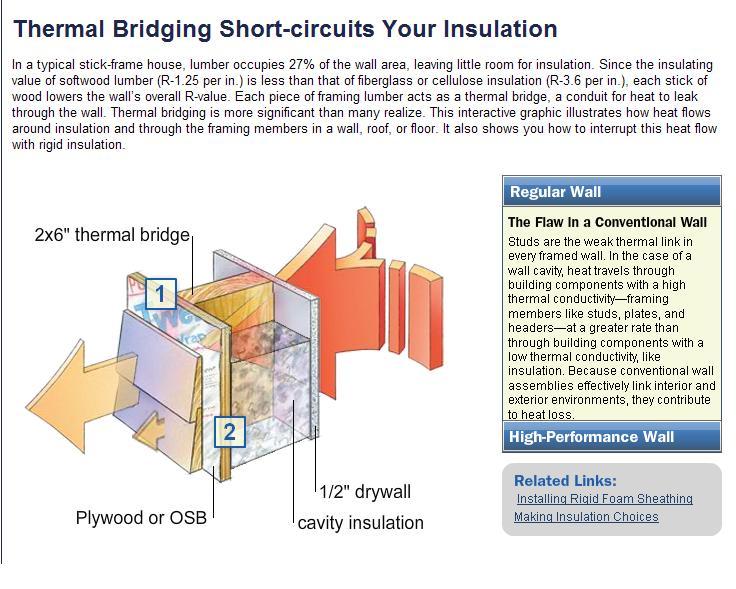
…but it’s really not. The traditional stick-frame house (which most of us live in) has walls built with lumber. 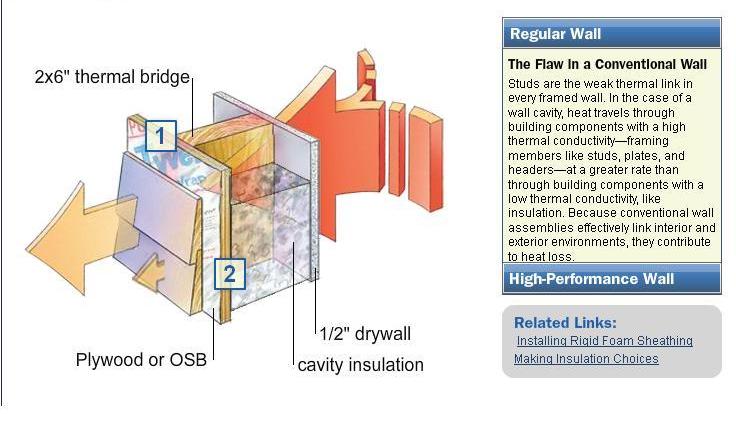 We put some insulation in-between the lumber and then attach interior walls. On the outside…if the house was built recently (in the past 30 years)…we hopefully have some plywood or OSB and then Tyvek house wrap. On top of that we put up our exterior siding of choice.
That sounds simple…and effective.
Or at least…I thought it would be effective. The framing lumber actually acts as a thermal bridge to help the heat escape from our homes through the walls. This reduces the overall effectiveness of the insulation and all our efforts to conserve energy.
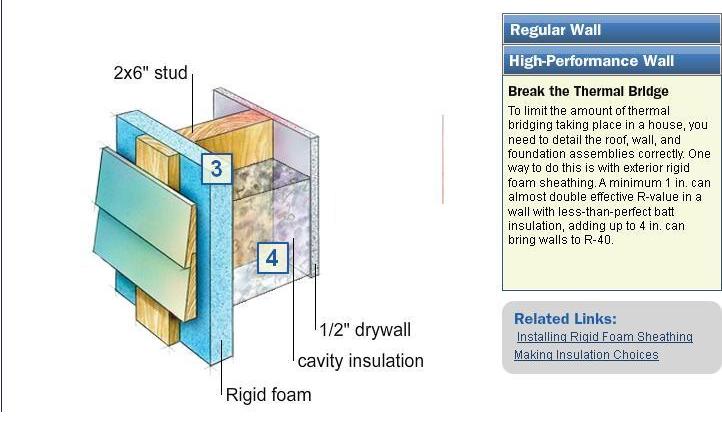 We can mitigate this mysterious concept of “thermal bridging” by adding rigid foam insulation to the exterior wall before we put on our exterior siding. A minimum of just one inch of rigid insulation can almost double the effective R value of a wall. The rigid foam (installed properly) creates the barrier that stops the thermal bridging and keeps more heat in our homes.
To see an interactive graph of the effect of thermal bridging on a traditional wall and a wall built with this in mind…click http://www.finehomebuilding.com/pages/thermal-bridging/. Fine Homebuilding has both a website and a magazine that you can pick up in your local Home Depot or Lowes. The website does have quite a few articles that are free without the subscription such as this one. It’s a great idea to think about when you’re doing your next home improvement project.
Last April, Techdirt pointed out that a financial firm in Texas was trying to attach “private transfer fees” to homes, so that developers would get a little bit of each sale as it passed among owners in the years to come. It sounded crazy then–imagine having to pay royalties on clothes or furniture whenever you resold them–but the firm is aggressively expanding its plan and has signed up more than 5,000 developers across the country, reports the New York Times. If you buy a new house in the next decade, look for a “resale fee” covenant hidden in a separate document that might not be included in your closing papers or even require a signature.

The Times says that one goal of including these resale fees is to pool them into new securities that can be sold on Wall Street. They could offer new revenue to struggling developers, but the real winner is the Texas financial firm masterminding this scheme, Freehold Capital Partners:
“Someone selling a home for $500,000, for example, would have to pay the original developer $5,000. If the home sold again two years later for $750,000, the second seller would have to pony up $7,500 to the developer, and so on. Even if a home declines in value, the seller still must pay the 1 percent fee. Freehold gets a cut of the resale fee; if the fees are securitized, it retains a percentage of the cash generated from the securitization.Freehold’s principals and lawyers have been aggressive in sales pitches to developers, but have declined to give details on their clients, securitization efforts or the company itself. Freehold moved its corporate office from Round Rock, Tex., to New York this year as it stepped up efforts to securitize the resale fees.”
“Resale Fees That Only Developers Could Love” [New York Times] (Thanks to gstitz!)
“Developers Trying To Treat Houses Like Copyright; Want A Cut Of Every Future Resale” [Techdirt]
 That’s right! New price and fantastic property! Almost five private acres bordering Wells State Park – you’ll never have a neighbor! Scenic…easy access to Pike/20/84 (three minutes to pike entrance)…unique log cabin with tons of extras! Wood stove, sun room, in ground pool…I could go on. It’s truly a “have to see” property because you won’t find anything else like it on the market.
The land is in two deeded lots and the second lot is buildable. Use it as an investment for the future or build a second house for family members. Keep it and preserve the “away from everything” feeling you get when you are standing in this house.
Open house today…Sunday September 12th at Noon until 2pm. Stop by!
To see the full details click here: http://298newbostonroad.epropertysites.com/

It’s perfect! 3 floors of living space! Deck, fireplace, skylights, privacy but yet all very convenient for commuters. 3 bedrooms on the top floor with a possible fourth in the finished basement (or make it a den / media room) with 2.5 baths. SPACE! This place has it! Stop by and check it out. Priced for the market and you don’t need to do anything to it.
For more information click here: http://26maplestreet.epropertysites.com/
Open house today from noon to 2pm


Water is the single most common cause of household damage, according to Jim Swegle, Vice President Safeco Personal Insurance, a Seattle-based homeowner’s insurance company. Roughly 30% of home water-damage claims results from appliance failure and another 62% from faulty plumbing systems, according to Safeco. The biggest culprits: water heaters and washing machines. And repairs are costly. Swegel says that American households with water damage spend as much as of $5,000 for each episode.
Some easy cautionary measures can lower the risk of water damage and dramatically reduce your reliance on plumbers. First, take stock. Make a checklist of your home’s water-based appliances and equipment — water heaters, washing machines, sump pumps — and note any wear and tear, especially on appliance parts (washing machine hoses, for example). Water heaters have a life expectancy that is hard to predict, so check yours monthly for puddling and follow all maintenance guidelines precisely. There might not be an immediately visible problem, but tanks can rust on the inside, leading to a rupture.
Hot water tanks should be replaced every ten to twelve years, says Swegel. Energy efficiency has come a long way – replacing your tank with a more modern one will result in energy savings, he says.
2. “I’m not really a plumber.”
A big chunk of the plumbing industry is made up of handymen, guys with tools and a little plumbing know-how. Although some of these Mr. Fix-Its are competent, many are not. The best way to minimize your risk is to hire a licensed plumber or at least one with a lot of experience. Licensed plumbers are required to abide by state regulations governing how the work is done and to follow local safety and building codes; they’re also more likely to carry liability and worker’s comp insurance. In states without licensed plumbers, your next-best bet is a licensed plumbing contractor, or at least someone who belongs to a plumbing trade organization.
“I can’t just go out and say I’m a plumber — just like I can’t click my heels and say I can put in irrigation” says plumber Roy Dillard, who works with certifications at the American Backflow Prevention Association. It’s important to leave the plumbing to plumbers, because they are technically protecting the public. “You don’t want just anybody plugging into the water supply,” he says.
Operating without a license or permit carries a lot of liability, but it happens. For instance, Dillard’s neighbor recently had her water heater go out, and was charged more than $1000 for a $200 hot water heater. She filed a complaint. “Come to find out he’d had his license suspended before for price gouging,” he says.
3. “My less-experienced underling will be over in a minute.”
Risa Hoag, a public relations firm owner, was surprised when much of the work in a new upstairs bathroom in her Nanuet, N.Y., home was done by people other than the plumber who gave her the initial estimate. That plumber, who was hired by Hoag’s contractor, visited the home and assessed the job, but was assisted by an apprentice. The assistant neglected to cap a radiator line, which eventually flooded and ruined the ceiling of the kitchen below. “No one checked his work, and we had to rip out a new ceiling,” Hoag says.
It’s common for plumbers to bring apprentices on a job; in fact, it’s a required part of the licensing process for trainees. However, although many states require a licensed plumber to supervise an apprentice, that doesn’t always happen. The best way to protect yourself is to negotiate personnel at the outset. Most plumbing companies, whether individually run or larger operations, have multiple jobs going at once, so it’s common practice to send employees or even trainees along with (or instead of) the guy whose name is on the side of the truck. But you can insist that a licensed plumber or plumbing contractor be present on the job, either to work or, at the very least, to supervise.
4. “I don’t do cleanup.”
Plumbers will often rip up a wall to look for the source of a leak. Some will alert you to this ahead of time; others won’t. Many plumbing problems are hidden, requiring walls, tiles and floor boards to be removed. And while a little demolition is hard to avoid, many plumbers won’t repair the damage they’ve made, arguing that if the plumbing has been fixed, their work is done. “You should always consider whether the job includes the repair of the house structure and cleanup,” says Marc Edwards, a professor of civil engineering at Virginia Tech, who specializes in home plumbing engineering.
If your plumbing job is part of a renovation, chances are your general contractor will be responsible for repairing anything that was altered for access. To be certain, draw up a contract for any job (assuming it’s not an emergency) stipulating that the plumber will provide a damage estimate.
When possible, hire a neatnik over a chaos machine. After the disaster in their home, Risa Hoag and her husband found a new plumber whose “truck was meticulous,” Hoag says. “He showed up with his own drop cloths and covered everything: rugs, hardwood floors. He kept the holes he made to a minimum, and he was immaculate.”
5. “Your favorite home-improvement store is making things more difficult.”
The truck of a well-prepared service plumber should have enough basics to handle most common emergencies: copper tubing, faucet parts, replacement hoses, rubber washers, fittings and standard tools. “You want to solve as many problems as you can in the one visit, so the more-well stocked you are, the better your chances,” says Billy Silk, a licensed plumber and owner of Silver Spring, Md.-based Master Plumbing & Mechanical.
Plumbers will get a feel for what products are available in their area, so they typically stock the parts for those products. However, the increase in options to homeowners has resulted in more custom and unusual parts, says Silk. “But with home and design centers, there are a lot of particular things that are out there, so a lot of times we don’t have those,” he says. When a customer has an odd type – or a non-brand name – faucet, for instance, Silk will try to locate parts for them and then do a return visit.
A good plumber should ask questions when you call the problem in, so he’ll know what to bring in the first place. Requirements can change dramatically if the job is more than just a service call — part of a renovation, for example, or at an older home. In some cases, a plumber may ask the client to obtain specialized fixtures or aesthetic items beforehand. “If the client knows what he wants and likes, or if a designer has gotten something before, he probably can get it faster than I can,” Silk says.
6.” You get a say on parts.”
In the event a plumber has to order a part, you can be part of the process. Master Plumbing & Mechanical’s Silk says he will shop online alongside a customer, to find the right products – and things that they like. They will shop together, so that there’s no mistakes with model numbers, or if it’s not available online, he’ll send a picture to a parts specialist and track it down. He’ll then give the customer a price to purchase or install the item.
Hiring a licensed plumber assures a customer of a basic level of experience. But it doesn’t guarantee that he or she can handle absolutely anything that comes up. Several years ago, a client hired Harvey Kreitenberg, a Los Angeles-based licensed plumber, to install new fixtures made by a German manufacturer. “I wasn’t familiar with the products, so I asked him to give me one of each of the various fixtures to play around with,” Kreitenberg says. The client agreed, and Kreitenberg spent a few days testing the fixtures before starting the job. “I admitted my ignorance, and they appreciated it,” he says.
Be aware that even the best-intentioned plumber can be flummoxed; it doesn’t always mean that he or she isn’t qualified. Recently, there have been a number of innovations and changes in water heaters, for example, and there are many more toilet varieties than there once were, with different kinds of flushing mechanisms. If you have a special problem, or have fixtures or plumbing that is somehow out of the ordinary, say so up front. That way, the plumber will know if he needs to bring another expert to the job or needs a little extra time to brush up.
8. “Emergency? You’re tenth in line.”
Although an unresponsive plumber might seem like a sign of a shoddy operation, it can also be the sign of someone in demand. Because so many plumbers are mediocre, good ones tend to be consistently booked. If you find someone you like, it may be worth sticking out the wait, especially if your home is old or complicated. Tell the plumber you don’t mind waiting for a house call but that you’d like your phone calls returned promptly. He may be busy, but he’ll appreciate the loyalty and will want to keep your business.
How long it takes a plumber to respond could depend on the size and traditional focus of the company. For instance, if you call someone who specializes in new construction to do a household repair, it will take them a little while, says Dillard, the plumber. Some plumbing companies now rate the urgency of their customers’ calls. If a customer wants an “emergency response,” it will cost more money, sometimes twice as much, to come within a couple of hours, versus being able to schedule something for the next day, Dillard says.
9. “Move your sink? Let’s not.”
A plumber may tell you that moving certain fixtures — transferring a sink to a new spot in the bathroom, for example — can’t be done. But despite a few exceptions, such as moving a toilet, which is admittedly complicated, in most cases it’s doable, says Beaufort, S.C.-based architect Jane Frederick. It just requires some extra parts and a willingness to spend a little more time and money on a job.
When faced with a reluctant plumber, spend a few more minutes asking him to explain why your wishes aren’t possible; ask specifically about special parts that might be required. If, for example, the reason he cites against moving a bathtub is the distance between the tub’s drain and a pipe, the problem may be fixed by rerouting the piping or relocating a fixture, Frederick says. If your plumber says specialized parts are necessary, offer to find and pick them up yourself, and offer to reschedule the appointment. A demonstrated willingness on your part to help out a plumber with a more involved task gives him the incentive to tackle the job; so will your willingness to pay a little extra for the additional steps required.
A general rule of thumb: If the room you’re changing is on the first floor or in the basement, moving any appliance will likely be easier. First floors tend to have a crawl space underneath, offering easy access to the plumbing, and in basements pipes are often exposed, making work easier.
10. “I could’ve walked you through this repair over the phone. But, hey, there’s no money in free advice.”
There are many plumbing emergencies a homeowner can handle on his own, especially with a little advice from a pro. Silk, the Maryland plumber, says a good plumber should be willing to talk through a problem with a customer on the phone. Local plumbing-supply shops can also offer guidance and tips for simple repairs such as a leaky faucet or a shower-head replacement, he says.
Ken Alligood, a sales associate at R&D Plumbing Supplies near Seattle, says many customers come in to ask how to fix something themselves. Alligood says staff members do their best to help customers and, if necessary, refer them to a plumber.
The unstable market has put some buyers on hold, but one housing expert says it actually makes sense to buy now.
Posted by Mai Ling at MSN Real Estate on Tuesday, September 7, 2010 11:18 AM
With the homeownership rate at a decade low and home sales at a record low in July, it’s obvious that potential homebuyers are going to need more than rock-bottom mortgage interest rates and more affordable home prices to lure them into the market.
How about some words of wisdom from one of the housing industry’s gurus that now is the time to buy?
Karl Case, who co-created Standard & Poor’s/Case-Shiller home prices indexes, writes in a New York Times op-ed that although the current housing slump means economic recovery will likely take years, it has also created a market in which “buying a house now can make a lot of sense.”
Of course, that’s easier said than done. With the unemployment rate at 9.6%, not to mention today’s tighter lending standards, buying a home is simply unattainable for many people.
But for those who are wavering on the sidelines, Case explains that even if home prices don’t skyrocket like they did in the first part of the past decade, buying a home still is not only an investment in your future, but also one that you’ll benefit from every day you live there. Case writes:
Consider it this way: When Enron went belly-up, shareholders ended up with nothing, but when the housing market drops, homeowners still have a house.
Let’s not forget that homeowners can deduct the interest paid on the mortgage, which opens the door to other deductions that many renters don’t get the opportunity to take advantage of.
But the real savings are going to come from today’s low interest rates, and homes prices that have fallen nearly 30% from their peak in summer 2006. Case does the math for you:
Four years ago, the monthly payment on a $300,000 house with 20 percent down and a mortgage rate of about 6.6 percent was $1,533. Today that $300,000 house would sell for $213,000 and a 30-year fixed-rate mortgage with 20 percent down would carry a rate of about 4.2 percent and a monthly payment of $833. In addition, the down payment would be $42,600 instead of $60,000.
And keep in mind, rent prices may have fallen in the past few months, but rents are about to go up, so you might even save money by buying rather than renting.
But then again, there’s always the possibility that home prices could fall by another 30%. Case seems unconvinced, but what do you think? How much further do you think home prices have to fall?

from wikiHow – The How to Manual That You Can Edit
Duct tape. Ubiquitous. Handy. Probably in your house right now. Apart from using it for sticking things together, there are so many things you can use it for that it would be a shame not to put it to greater use. Here are just some of the many ways you can make the most of duct tape.
This video shows how to make duct tape fabric which can then be used in a variety of duct tape crafts.
Article provided by wikiHow, a wiki how-to manual. Please edit this article and find author credits at the original wikiHow article on How to Use Duct Tape. All content on wikiHow can be shared under a Creative Commons license.