Real Estate and *stuff *
A real person helping real people with real estate
You can scroll the shelf using ← and → keys
You can scroll the shelf using ← and → keys
 Your bathroom, one of the rooms you clean most, hides areas that rarely see a scrub brush. It’s time to tackle these 5 nasty spots you probably forgot.
If you can’t remember the last time you cleaned your bathroom, we don’t want to know what’s living in your tub. Probably, a host of staphylococcus, the skin infection bacteria that, a recent study showed, more frequently grows in tubs than in garbage cans.
But we presume you or someone else regularly swishes out the toilets, wipes out the tubs and sinks, and mops your bathroom flooring.
But you may be missing some critical areas. With the help of Kristi Mailloux, president of Molly Maid, here is a compiled a list of 5 bathroom spots home owners often forget to clean:
1. Showerheads: A warm white vinegar bath will get rid of mineral deposits, making your low-flow shower head flow even lower. Let the showerhead soak for about 20 minutes, then poke a paperclip into shower head holes still clogged. Scrub with an old toothbrush, then rinse and repeat if necessary.
2. Toilet bases: Mildew can grow on the caulking around the base of your toilet. Spray with white vinegar or disinfecting household cleaner, then scrub with a hard-bristled brush. Dry thoroughly.
3. Shower curtains: Clean soap scum and mildew from plastic shower curtains by tossing them into your washer on the gentle and cold (never hot!) water cycle, with detergent and ½ cup vinegar. If mildew is present, add ½ cup of bleach instead of vinegar. Toss a couple of large towels into the machine to act as scrubbers. Hang curtains back on your shower curtain rod, spread them out, and let them drip-dry. If you turn on the bathroom fan, they’ll dry faster.
4. Drains: We don’t usually pay much attention to drains until they’re clogged. But all year your hair, toothpaste, shampoo, and conditioner are building up in sink and tub drains. Remove the stopper — unscrew the shower drain — and clear away obvious gunk, like hair and soap. Soak the drain in vinegar to clear away mineral deposits. Then, pour boiling water, or a mixture of ½ cup white vinegar and ½ cup baking soda, down the drain, which will bubble away crud sticking to pipes.
5. Medicine cabinet: Throw out prescription and over-the-counter drugs you no longer need or want. But don’t dump them down the drain, where they become part of the watershed, or into the trash, where anyone can fetch them out. Instead, take them to a local collection site, often at police or fire stations. Or check U.S. Drug Enforcement Administration’s National Take Back Initiative’s website for dates and sites for their next collection.
Space heaters used to be clunky plugins that squatted on the floor and scared the fluff off your cat. No more — these 5 space heaters are totally cool.
 This radiant heat panel — the mirror and towel bar on the left — is so integrated into this bathroom that you may not even notice it. Image: Warmly Yours
You’ve probably heard of radiant heating for floors, created by snaking heating tubes or cables under floors. But that’s not the only application for this efficient, quiet method of heating. Manufacturers now produce radiant panels for walls, ceilings, and other locations.
Radiant heat, also known as infrared radiant heat, is especially efficient, heating solid objects such as chairs and people without heating the air. The warming effect of radiant heat is practically instantaneous, and solid objects store the heat and stay warm even after the system switches off.
(Forced-air heating does the opposite, heating the air first, which then eventually warms people and surfaces. When a forced-air system shuts off, temperatures fall rapidly.)
Radiant panels come in many sizes, from a couple of square feet to 30 square feet and larger. Because no heat is lost in air ducts (there aren’t any), radiant panels are especially energy efficient, and the use of supplemental radiant panels to selectively heat rooms helps reduce annual energy costs by 10% to 30%.
 Finding the best heating solution for a specific situation is a fine art — sometimes literally. A thin-film, infrared radiant panel made by Prestyl USA hangs on a wall and looks just like artwork, custom-printed with a design or photo you submit.
“We just need a digital high-pixel image that you have the rights to,” says the president, Thom Morrow. “So no Seattle Seahawks logos. But a portrait of the family, fine. Or dog or horse or the old family farm.”
These plug-in art panels project out from the wall just 1½ inches. Inside is a carbon-based material that absorbs energy when current passes through. The panel then releases the energy as infrared light waves.
An artistic panel isn’t cheap, but you can take into account what you might spend on equivalent artwork. Prestyl’s plain 2-by-2-foot panel, suitable for an 8-by-10-foot room, costs $352, plus $180 if you want an image, or a total of $6.65 per square foot of living space.
 If you heat with electricity and live where electrical rates are lower at off-peak hours, an electrical thermal storage heater could save you money.
This kind of heater consists of a well-insulated shell filled with ceramic bricks that efficiently absorb and store heat. The bricks heat up during hours when power rates are low, then release the heat, using a blower, when the rate rises, potentially saving you hundreds of dollars a year.
Al Takle, national sales manager for Steffes Corp., says the units only make sense where rates dip for part of the day. Where’s that? He listed:
Thermal storage heaters sit on the floor and are about 12 inches deep, 24 inches high, and 30 to 60 inches long. They require only a little clearance on sides and the top, so you can easily build them into bookcases or window seats. Costs range from $1,200 (for a small bedroom or office) to $2,200 (for a 1,000-square-foot, open living room and kitchen space), or $2-$12 per square foot of living area.
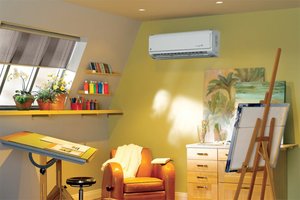 If you’re looking to retrofit an older home that doesn’t have ductwork, or you’re adding on and tying into your existing HVAC system is problematic, a ductless heat pump could be the answer.
Developed in Japan 30 years ago, many heating contractors in the U.S. are just now learning about this option, also known as a mini-split. There are only two main components: an outdoor compressor unit and an indoor air handler, which is typically installed high on an outside wall.
A small tube delivers conditioned air directly to the room. Because there’s no long expanse of ductwork, ductless heat pumps operate up to 50% more efficiently than traditional forced-air systems.
The installed price is around $5,000 for equipment that handles 1,100 square feet, or $5.45 per square foot of living space. Many power companies offer rebate incentives, sometimes for as much as $1,500, to customers who switch from other kinds of electrical heating.
 For a floor-model space heater that’s out of this world, look to Dyson — the company that seems to delight in reinventing ordinary household items.
The Dyson Hot fan heater looks like a space creature that never got around to developing a face. It generates heat like any other electrical-resistance heater, but there’s no visible whirling fan, so you don’t have to worry about whether a curious kid will stick in a finger to see what happens.
Even though you don’t see a fan, the heater does blow out a steady stream of warm air. The heater pushes air over its curved surfaces to increase output, much the same way an airplane wing accelerates air flow. The fan head oscillates, and you can tilt the device to direct the air flow.
The Hot fan costs $400 and is suitable for small to medium-size rooms, or about $4 per square foot of living space for a 10-by-10-foot room.
 The State of the Union address and the upcoming Florida GOP primary are bringing new and much-needed attention to housing issues. Here are the top five articles on the housing crisis and how the politicians are looking at it.
President Barack Obama’s proposal for enhanced refinancing efforts sparked a new dialogue among members of Congress and the media after the State of the Union Tuesday. Issues like the size of down payments, principal write downs, and how to take advantage of low interest rates are suddenly gaining traction among lawmakers. Even the GOP candidates for president are having to face the housing crisis as they campaign in Florida, a state hard hit by foreclosures.
Associated Press: After Obama Speech, Three Arguments for Housing
President Barack Obama said in his State of the Union speech that he wanted to help struggling home owners refinance their mortgages. The Republicans who want his job say the government should get out of the way of the housing market. But some experts advocate something much bolder to provide relief to the 11 million home owners in the United States who owe more on their mortgages than their houses are worth.
MSNBC Bottom Line: Home Buying Could Soon Beat Renting
Falling home prices have sent many would-be buyers to the sidelines. If all goes well, record low interest rates and rising rents may soon prompt some of them to take a second look at buying.
New York Times (Bucks): Big Down Payments Could Bar Creditworthy Borrowers From Market, Study Finds
Requiring a minimum down payment of 20%, or even 10%, on home loans would push many creditworthy borrowers into higher-cost loans or out of the mortgage market entirely, a new study says.
HouseLogic: Finally Some Talk on Home Ownership; Will Action Follow?
It was nice to finally hear a politician talking about solving our housing market woes — the bull’s-eye in terms of economic recovery. Aiming to strike a populist chord with voters, President Barack Obama asked Congress Tuesday night during the State of the Union to pass a mass refinancing effort that would help home owners take advantage of today’s lower mortgage rates.
USA Today: Florida Primary Turns Spotlight on Housing Bust’s Fallout
As the GOP presidential contest heads to Florida, the Jan. 31 primary looms as the first in the nation where declarations by Romney and former senator Rick Santorum that housing should be allowed to bottom out will be judged by voters in markets where the housing bust has been concentrated.
 Oh yes – we still have a few more resolutions to keep up with! It’s still January! Based on the most-common top-ten resolutions gathered by “Time” magazine, USA.gov, and other sources, here is #3 on an inspiring list of home management goals.
3. Get out of debt (budget for improvements)
Creating a yearly budget for home improvement and maintenance helps prevent overspending, and encourages you to put aside money for major replacements — such as new roofing or a kitchen appliance — that come up every few years.
Protect your home finances by knowing how much you’ll probably spend each year. Data from the U.S. Census Bureau says that average annual maintenance and home improvement expenditures are about $3,300 per household. Leading lending institutions agree; HSH Associates and LendingTree.com place average costs of yearly maintenance and upkeep at 1% to 3% of your home’s initial price.
That means the owner of a $250,000 home should budget between $2,500 to $7,500 each year for upkeep and replacements. Have extra at the end of the year? Save it for more costly upkeep and replacement items down the road — you’ll probably need it then.
When the new year arrives, promises and resolutions abound. Here’s the top-10 list of what the resolute home owner should accomplish this year. Here’s Number Two on the Top 10 List of New Year’s Resolutions for your Home…

The EPA lists indoor air quality as one of the top environmental health hazards. That’s because indoor air is full of potential contaminants, such as dust, mold spores, pollen, and viruses. The problem is at its worst during winter, when windows and doors are shut tight.
You can help eliminate harmful lung irritants in your home with these maintenance and improvement tips:
This time, it’s going to be different. A brand new year, brimming with possibilities, and you’ve resolved to move through your house like a whirling tornado of can-do, fixing and painting and organizing. This year, nothing will stop you.
Welcome to your home improvement New Year’s Resolutions.
Based on the most-common top-ten resolutions gathered by “Time” magazine, USA.gov, and other sources, here is an inspiring list of home management goals.
Ready for 2012? Here it comes the first of the top 10 New Year’s Resolutions for your home:
1. Lose weight (cut energy use)
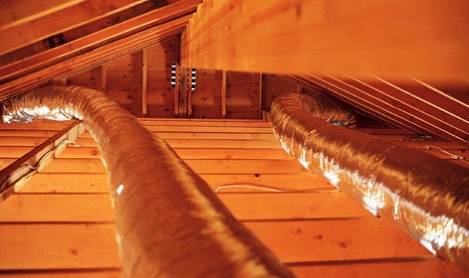 Your house is a glutton, gobbling energy like a starved elephant. Gain control by trimming energy use.
A good place to start is your HVAC ductwork. Ducts are notorious energy-wasters, leaking your heating and cooling air through holes and loose connections.
Sealing and insulating your ductwork can improve the efficiency of your heating and cooling system by as much as 20%, saving you $200 per year or more, according to Energy Star. You’ll make your home more comfortable, and a more-efficient system helps extend the life of your furnace, air conditioner, or heat pump.
Because ducts are usually hidden inside walls, ceilings, attics, and crawl spaces, sealing and insulating them may be a difficult and time-consuming DIY job. If you can’t reach all your ducts, concentrate on those that are accessible.
Use duct sealant — called mastic — or metal-backed tape to seal the seams, holes, and connections. Don’t use the confusingly named “duct tape,” which won’t provide a permanent solution. Be sure to seal connections at vents and floor registers — these are likely places for leaks to occur.
After sealing your ducts, wrap them in fiberglass insulation. Most hardware stores and home improvement centers have insulation wrap products made for ducts.
A professional heating and cooling contractor will charge $1,000 to $4,000 for the work, including materials, depending on the size of your home and accessibility to your ducts.
Insulating your ductwork may qualify for a rebate from your state or local municipality. Check the Database of State Incentives for Renewables & Efficiency.
 You have a single-family house you’d like to rent out. Perhaps you’re temporarily relocating for work, or maybe you inherited your childhood home from your parents, and you’re not quite ready to part with it yet. This has become a very popular option for many home owners but there is risk involved.
Renting can be a profitable choice, but it requires an investment of time, money, and organization to make it work. Here’s how to determine whether renting out your house is worth the cost.
Calculate your monthly expenses
You want to charge at least enough to cover your monthly outlay. So the first step is to use our free downloadable worksheet to calculate your costs. Start with regular expenses like mortgage, maintenance, and homeowners association dues.
You may also need to upgrade your insurance coverage. Your agent can advise you about adding landlord insurance, a special type of policy that covers rental properties. As a rule, landlord insurance costs about 25% more than standard homeowners insurance.
If you’re renting the house furnished, make sure you’re covered for the personal possessions you leave behind. Jane Cline, the insurance commissioner of West Virginia, tells owners to prepare a detailed inventoryof household items. If you’re renting the house unfurnished, figure in the costs of moving and storing your items.
Check out prospective tenants
As a practical matter, you’ll have to formally check out your prospective renters. MrLandlord.com, an information and service site for landlords, suggests a variety of background checks: credit reports, eviction reports, and criminal background reports. None of these is expensive, but you must get your prospects’ permission.
MrLandlord.com charges $8.95 for an eviction report. A combined credit and eviction report is $14.95. If you want to be especially careful, a countywide criminal report costs $29.95.
Account for maintenance and upgrades
Even with the most scrupulous checks, you can’t be completely sure renters will take good care of your home. Eva Rosenberg, an enrolled agent in Northridge, Calif., advises that if you’re not within easy driving distance of your rental property, you’ll need to arrange for someone else to keep an eye on the place, even if it’s just to make sure the lawn is mowed. If the tenants are neglecting upkeep, you’ll want to know about it sooner rather than later, since it could be a warning sign of trouble down the line.
Of course, even if the renters are conscientious, problems can crop up: boilers will fail; roofs may leak; washing machine hoses can burst. If household systems or appliances need repair or replacement, you’re better off spending the money up front, before the fix becomes an expensive emergency.
You may also want to invest in some of the “extras” that Sue Peters, a broker in Wellfleet, Mass., recommends adding to attract a tenant willing to pay a higher fee. She suggests spending money on air conditioning, expanded-channel cable TV, and a Wi-Fi network.
Don’t want the headaches? Hire a property manager
You can save yourself a lot of time and effort if you engage a management company to oversee the property and take care of the details. Some firms charge a percentage of the rental fee, others a flat monthly fee, based on the extent of services. Joe Aimone of GoRenter in Phoenix, Ariz., says his firm offers a variety of services, starting at as little as $50 a month, including general maintenance, rent collection, and—if necessary—eviction.
A management company can help you figure out how much to charge, find and vet tenants, and prepare a lease. It will also pay the real estate taxes on your behalf and present you with an annual 1099 form. Many management companies maintain 24-hour emergency lines and a roster of approved service people, so they can take care of plumbing or electrical problems and bill you later. A property manager will also see that driveways and sidewalks are shoveled, so you don’t find yourself with an unpleasant claim against your liability insurance.
Expect to pay a management company 8% to 10% of the annual gross rent, on average, with a $50 to $85 monthly minimum.
Keep scrupulous records
Whether or not you use a management company, you’ll have to keep extensive business records. DeDe Jones, CFP, CPA, in Lakewood, Colo., advises owners to save receipts for any expenses and to file them carefully.
The IRS treats maintenance expenditures, like a new hot-water heater, differently from capital improvements, such as a new deck or patio, so you’ll want to consult a tax professional. Meanwhile, keep the two types of receipts separate to make tax prep easier. You’ll have to file Schedule E on Form 1040, which can also serve as a template for the kinds of records you’ll need.
Finally, because of the complex tax and liability issues involved, many financial experts suggest forming a corporation when you become a landlord. An attorney can advise you about whether incorporating makes sense in your situation.
Last year we started a conversation about the energy costs of Christmas lights displays. We think it’s worth pursuing this year: What’s your take? Are they a waste of energy or something that shouldn’t have a price tag attached?
 Last Christmastime, we were so blown away by the Faucher family’s million-bulb holiday light show in Delaware that we did what could only be done — calculate how much the dazzler costs to power up for a month: $82,320!
At least according to an online calculator we found.
Well, the post went viral and caused a quite a hubbub.
Some commenters called the Fauchers planet killers: “OMG does this guy not realize that there is something called GLOBAL WARMING that is threatening to destroy the planet and that all of these useless and ugly lights are making this problem so much worse!”
Some called dissenters the Grinches who stole Christmas lights: “I think it’ s great, something bright and happy to look at in these days of doom and gloom.”
And some just disputed our math and called the numbers “bogus.”
Our favorite comment came from “Santa Claus, New Castle, Delaware” (but we’re pretty sure someone in the Faucher family wrote it.)
The writer called the article “informative and very well written” — thanks Santa! — but said that his energy bill isn’t anywhere near $82,000.
We tried to reach Wilmington’s Santa for an update, but this is his busy season and he didn’t call us back. Instead, we talked the Smith family in North Delaware, who told us all about their 400,000-bulb light display. (What is it with Delaware and over-the-top holiday lights? Anyway, I’ll be posting some tips from the Smiths tomorrow.
But mainly, we’re curious about your reaction, since saving energy is pocketbook-smart — but holiday cheer, after all, is priceless.
So, do you vote for “pocketbook” or “priceless”? Why?
 Landlording is a great business for some…and poor business for others. It’s an attractive idea and there are certainly many “investment” properties on the market with happy taglines like “live mortgage free!” and “investor special”. But there are some things you should know before starting your adventures as a landlord. Even before you think about cap rates, repairs and building structure.
It might sound simple, but real estate pros warn that there’s a lot to know. The landlord who doesn’t follow such basic guidelines as conducting a thorough background check can get stuck with a nightmare tenant. It takes both business sense and common sense.
“Most of my tenants, 98%, are terrific,” said Jupiter real estate broker and investor Carl Presto, who owns 60 properties. “The problem is that 2%.”
The down economy that has resulted in real estate bargains also means it’s more difficult to find a tenant who can afford to pay first and last month’s rent and a security deposit up front. Landlords report they are having to go through 30 to 40 applicants before finding a qualified tenant.
Landlords also find they are competing with foreclosed houses, which some people rent below market, forcing rents lower.
Although picking up a cheap condominium unit might be tempting, David Dweck, founder and president of the Boca Real Estate Investment Club and a real estate broker and investor, advises avoiding them.
Instead, buy a duplex, triplex, small apartment building, or single-family home where you won’t be subject to a condominium board, he suggested.
Special assessments levied by condo associations can run into thousands of dollars.
Presto agrees: “Pay cash and buy a duplex. Offset your rent. Rent one side, and live in the other.”
Financing is also difficult. Douglas Rill, a West Palm Beach real estate broker who has been a landlord for 38 years, said about 70% percent of investment properties are cash deals.
Whatever the property, Dweck, Presto, Rill and other experts say finding a decent tenant starts with the screening process.
Credit checks and criminal background checks are a must. Small-scale landlords can find help at websites such as http://www.mysmartmove.com. Operated by Trans-Union, a major credit bureau, SmartMove gives independent rental owners access to the same tenant screening used by large property management groups. It also gives renters data privacy because they provide their identifying information directly to TransUnion in a secure, online setting.
For $25, the landlord receives a credit-based leasing recommendation, national criminal report including 50 state sex-offender and terrorist searches, renter fraud warnings, and automated renter identity verification.
For an additional $5, the landlord also can get access to a credit report, a credit score, and a detailed rental address history.
The $30 is well spent compared with the basic eviction filing fee, which can get into the 100’s of dollars.
A West Palm Beach landlord contacted recently did not conduct a background check. Now he has a tenant whose true identity is a mystery. “My experience with landlording has not been positive,” the man said. “I am in the middle of an eviction and the person will not say who he really is.”
Lawyer review of lease form advised
A written lease is essential. Standard leases are available for free at sites such as http://www.mrlandlord.com or can be purchased at office supply stores. Have an attorney review the lease form you select and modify it specifically for your property.
Of course, leases cover such basics as the term of the lease, when the rent is due and how much the rent is. But they also should include sections on policies about late rent, security deposits, and how many people are allowed to live on the premises and that the premises are for residential purposes only.
The lease needs to state what might seem obvious. Many landlords err by not spelling out everything. If you don’t allow pets, don’t just say, “No pets.” State that no pets of any kind are allowed, including visiting pets. Or one day you will knock on your tenant’s door to find her holding a ferret, as one landlady did.
Don’t just state that parking is provided. Be specific. For example, the lease created states that the tenant must park in his or her assigned space.
Don’t simply state that the premises must be left clean and undamaged in order for the tenant to receive his damage deposit back after he moves out. Lease requires tenants to comply with a number of conditions, such as having the carpet professionally cleaned and cleaning the entire home, including the range, oven, refrigerator, bathrooms, closets, cabinets, windows, carpet, and balcony, etc.
‘Professional tenants’
No matter how ironclad the lease is, what some experts call “professional tenants” do exist. These are people who move in and never pay rent. They know that it often takes awhile for an eviction to be carried out.
“Anything is only as good as the tenant’s word. They can still walk out on you,” said a landlord. “I went to court on an eviction. The guy said, ‘Yes, I owe the money.’ The judge said I did not properly file the three-day notice. The name and address were supposed to be on the bottom right-hand side. It was at the top on my letterhead. It cost me a couple thousand and the guy owed me four grand. I never got paid.”
Landlording is a business, and experts say it’s not for the soft-hearted.
When rent is past due, most state laws require landlords to give tenants notice that they must pay the rent or move. If the rent is not paid, then the landlord can begin legal action to evict the tenant.
“You have to be on top of it. The stories can get ridiculous. I keep a notice act in my car. I have had people tell me they will not pay the rent because they are buying Christmas presents,” a landlord said.
Don’t start your new line of income off without getting the facts. Consult with a good attorney and hire a good Realtor to assist you. Do your homework on the property, the area and the rental history. Make sure that you can weather vacancies and repair as well as unpleasant situations such as evictions and difficult conversations.
 While shoppers were trampling each other to get the season’s hottest stuff, a glimmer of hope emerged for the economy. Does it have legs?
A woman pepper-spraying her fellow shoppers to better her chances of getting an Xbox. A crowd of people stepping over the body of a heart attack victim, worrying less about his fate and more about their Christmas purchases. Violence, mayhem, and chaos seemed to be the stories making headlines on Black Friday.
Despite this bad behavior, the traditional first day of holiday shopping was a big success for the nation’s retailers, and a sign of life in what has been a bleak year for the American economy. Black Friday sales increased 6.6% over the same day last year, according to ShopperTrak. That amounts to $11.40 billion in retail purchases and the biggest dollar amount ever spent during Black Friday.
Cyber Monday outshone last year’s numbers, too.
But will this seasonal boon for retailers continue beyond the New Year — and translate into a broader economic recovery that affects other industries, such as housing?
The Thomson Reuters/University of Michigan final index of consumer sentiment rose to 64.1 (out of 100) in November, the highest since June, from 60.9 in October. The Michigan survey’s index of current conditions, which reflects Americans’ perceptions of their financial situation and whether they consider it a good time to buy big-ticket items like cars, increased to 77.6 from 75.1 the prior month.
All of this seems to be good news. But we aren’t out of the woods. The housing sector remains a problem. Bloomberg News quotes analyst Michelle Meyer, a senior U.S. economist at Bank of America: “Demand for new construction remains weak … Builders are still competing with the significant overhang of existing homes for sale. Overall, the housing market remains out of balance, with much more supply than demand.”
A NATIONAL ASSOCIATION OF REALTORS® survey shows the unsettled and variable story of housing, with sales of previously owned homes rising 1.4%, but prices dropping 4.7% between September and October. Distressed properties, including foreclosures and short sales, made up 28% of those purchases.
What does this all mean?
Consumer confidence is inching its way back up, but housing is still a big drag on the economy’s future growth. Policy makers should take note, and avoid doing anything to make the housing market worse. Give consumers confidence that they can buy homes now (deals and rates are great!), and won’t face any change in the rules (especially the elimination or reduction in the mortgage interest deduction) in the future.
We’re seeing some signs of life in the economy. Let’s hope it continues and policymakers build on the momentum.
Do you think the Black Friday numbers indicate a general uptick in the economy, or is it a seasonal blip?
 Real Estate and *stuff *