Real Estate and *stuff *
A real person helping real people with real estate
You can scroll the shelf using ← and → keys
You can scroll the shelf using ← and → keys
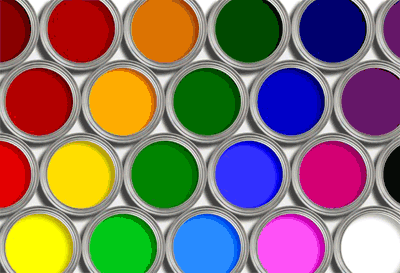 What’s in a paint color name?
Whether it’s Harbor Fog, Just Peachy, or Van Buren Brown, an enticing paint color name has the power to excite, persuade, and ultimately close a sale.
But no matter how much Crème Brulee or Butterscotch Tempest may whet your appetite for freshly painted walls, your satisfaction is going to come down to good surface prep, and selecting a top-performing paint.
Do paint names come from thin air?
Creating paint names is more serendipity than science. And, it turns out, no two paint namers name alike.
“There’s no book on this; very few people do this, and we all do things differently,” says Mary Lawlor, manager of color marketing for Kelly-Moore Paints. In a typical year, a professional paint namer may be asked to come up with hundreds of new names — all checked against a master databank of paint names for originality.
Flowers, which stimulate scent and sight, are wellsprings of inspiration. Places, such as the French Riviera or Monte Carlo, evoke enviable lifestyles. And fabrics — satin, cashmere, even mohair — recall texture and feel.
But nothing stimulates the color imagination like food, which adds taste to the mix of memories.
No matter what it’s called, a paint by any other name is still a paint. To get results you love, buy quality paints and take the time to prepare surfaces properly.
Top-rated interior paints recommended by Consumer Reportsinclude:
For good surface prep, follow these guidelines:
If you could name a paint color, what would it be?
When the new year arrives, promises and resolutions abound. Here’s the top-10 list of what the resolute home owner should accomplish this year. Here’s Number Two on the Top 10 List of New Year’s Resolutions for your Home…

The EPA lists indoor air quality as one of the top environmental health hazards. That’s because indoor air is full of potential contaminants, such as dust, mold spores, pollen, and viruses. The problem is at its worst during winter, when windows and doors are shut tight.
You can help eliminate harmful lung irritants in your home with these maintenance and improvement tips:
I just had to do something fun today with all this winter snow/no power stuff! We’ve all seen them, lurking around the corner, maybe in the next neighborhood: houses with unaccountably strange paint jobs. As entertaining as they are to look at, odd ducks like these might deter future buyers and tend to lower property values of nearby homes. Check out these extreme exteriors to learn how your home’s fresh coat can look good and preserve the worth of your home and neighborhood.
 The exterior of your house says a lot about you. But even if you have the most exuberant personality on your block, you still have an obligation to fit in with your neighbors. This is especially true if your property is part of a home owners association — an HOA. Most HOAs have strict rules about the style of your house, your choice of paint colors, and other criteria that help preserve the property values of nearby homes.
Credit: Joanne Teh/Flickr
 Choosing great exterior colors means selecting body, trim, and accent colors that complement each other. If chartreuse and salmon are your idea of a cool combo, you’d be wise to check out an app like ColorSnap from Sherwin-Williams. Take a photo of your property, and ColorSnap suggests harmonious color combinations for your house. The free app is available for iPhone, Android, and Blackberry.
Credit: Chad Miller/Flickr
 Painting foundation walls neutral colors emphasizes the body color of your siding — hopefully that’s a good thing. Rough-textured concrete block and poured concrete foundation walls are tricky to paint, and finishing them is a time-consuming project. Use an exterior paint formulated for concrete and masonry.
Credit: John Boyd/Flickr
 Artist Peter Kaschnig certainly was in his blue period when he painted this entire house in Klagenfort, Austria, a royal azure. While Kaschnig managed to cover every nook and cranny with blue paint — including roofing and windows — he spilled nary a drop on the surrounding lawn, thanks to proper use of tools and drop cloths.
Credit: Paul Ott photo/Blue House — Peter Kaschnig
 If you want to green up your exterior paint job, selecting bright green paint isn’t exactly what we had in mind. Get with environmentally friendly techniques by selecting low-VOC paints and recycling your used paints and stains.
Credit: Eric Allix Rogers/Flickr
 If you lived here, you wouldn’t have much trouble finding your house, day or night. Keep your polka dots bright with regular maintenance that includes cleaning your siding, repairing cracks and damage promptly, and refinishing with high-quality exterior paints and stains.
Credit: Michelle Figurski (photo)/Tyree Guyton/Heidelberg Project
 Whatever the color, the abandoned, horror movie look is never inviting. But before you start sanding and scraping, test for the presence of lead paint. If your test is positive, read up on lead paint laws that describe how to deal with the problem safely.
Credit: AD Gimenez
 Multiple colors are eye-catching but spell trouble when it comes time to repaint. To reduce ongoing maintenance, choose a base color and one or two trim colors that simplify repainting. Top-quality exterior paints may cost more initially but will pay for themselves in reduced upkeep costs over the years.
Credit: © PJ Taylor Photography, 2008
 With its dark red door, black shutters, and crisp white trim, this Colonial house has a classic color scheme — unless you factor in that dash of marketing bling on the siding. No matter what color or message says “pride of ownership” to you, you’ll get the best results using the right painting tools, brushes, and rollers.
Credit: Adzookie Inc.
Would you paint your house in any of these extreme ways? I admit…I just might!
 Real Estate and *stuff *