Real Estate and *stuff *
A real person helping real people with real estate
You can scroll the shelf using ← and → keys
You can scroll the shelf using ← and → keys
 New year, new list of remodeling projects to start around the house. At least that’s what remodelers and contractors are hoping.
So, what remodeling projects are on top of everyone’s list?
The National Association of the Remodeling Industry (NARI) conducted an exclusive poll of their top builders and developers for us and found that while most people are not starting major renovation projects due to the economy, now is the time to take care of the smaller jobs around your home.
Call it the over-arching remodeling trend for 2011: Tackling small projects while you wait to do the really big remodeling project that’s on your list.
1. Save Money: Remodel Your Bathroom. Old tile getting a little grungy? It looks like 2011 is the year for a bathroom update. Dennis D. Gehman, president of Gehman Custom Remodeling says, “Bathrooms are the hottest project, we think it’s due to the economy. Baths cost less than a kitchen or addition and most houses have more than one bath, so there are more available to be remodeled.”
2. Must-Do Remodeling Projects. Rather than going through major renovations, next year people will continue to only complete the projects that need to be done, like repairs to siding or roof leaks. Mitch Speck of Specktacular Home Remodeling says he is seeing a trend of people doing “‘have-to’ projects instead of ‘want-to’ projects.”
3. Warming Up The House. Warmer tiles and colors are coming back. People tend to be moving away from minimalist, white designs in favor of cozier, earth tones. The trend, however, is not rustic. Instead, it’ss a mash-up of earthiness and modern design. Judy Mozen, president of Handcrafted Homes, Inc., says she is seeing people favor rooms that are more contemporary and calming, but are “still not totally contemporary.”
4. Getting Decked Out. George Christiansen of Pequot Remodeling Corporation says his clients are building outdoor spaces for themselves. “It appears that people want to sit outside again and are staying at home more frequently. Many pools are also being built in the neighborhood.”
5. Hiring A Great Contractor. Darius Baker of D & J Kitchens and Baths, Inc. says that “consumer diligence” is on the rise. “Folks are finally getting the message that it is important to look closer at the companies they are considering for their project. They are asking the questions we have been telling them to ask for years.”
6. Paying in Cash. Rather than taking out loans for renovation projects, homeowners are using cash for projects. Steve Klitsch of Creative Concepts Remodeling, Inc. says homeowners are giving themselves a budget and picking and choosing what projects they can do with the money. One way to save money is by updating features, like cabinets, but not remodel an entire room.
7. Opening Up Rooms: “Open floor plans are in, so we’re removing interior walls and opening up the spaces in older houses to modernize them,” says Gehman. Open floor plans help families be more flexible with the square footage they already have.
8. Bronze Age. Along the with warmer tones in homes are warmer tones in metallic features. Kathy Adams of J&C Adams Co., Inc. says “oil rubbed bronze, aged bronze, or distressed hardware” will be big in the coming year.
9. Going Green. Bamboo floors, grass thatched roofs, and bark siding may sound like something from “Jungle Book,” but they are just a few of the newest green home products. In addition, people are getting energy efficiency upgrades. Adams says upgrades on glass will be continue to be big, and adds that “people are even asking for tri-pane (windows)!”
10. Industrial Flair. Exposed beams will continue to be popular, but so will “stainless steel cable and architectural products,” says Michell Milestone, director of sales and marketing at JG Development, Inc. With so many people working from home, home will take on more of an industrial or commercial look to enforce business credability.
11. Creating Relaxation Space: With home values still falling in many areas and a new prediction of three more lousy years of real estate, homeowners are more stressed than ever. So it’s no surprise that when they are developing new spaces, tranquility comes to mind. Mozen says people are asking for “zen-like” bathrooms. “The bathrooms don’t have to be big-but they have to be relaxing and soothing. They seem to prefer showers with the works-steam, seats, body sprays, etc.”
12. Planning ahead: “We are seeing many clients thinking about their retirement years,” says Jillian Renner of Golden Rule Remodeling & Architecture, Inc. Her clients-even those far from retirement-are putting in easy-opening cabinetry, hand-held showers, and more accessible kitchens and baths. Renner adds, “Even though the clients don’t need those things right now, they are planning for when they might find them needed.”
Are you planning a remodeling project this year? How much are you planning to spend?
In the home — as in life — it’s often the little things that matter. And it’s amazing how many small structural things can go wrong around your house.
Whether it’s the front-door lock that won’t let you into your own home or the cracked window that won’t keep the cold out, small household problems can have a big effect. For most of these, there’s no need to call for repairs; the solution lies in tapping your ingenuity and using a few common household materials in innovative ways.
Even when it seems that the roof is falling in or the floor is opening up beneath you, there are often simple ways to solve larger problems on your own. Here are some quick fixes for your floor troubles.
That wood table was heavier than you thought, and dragging it across the room has left a nice long abrasion in your pretty wood floor.
The quick fix
The fix depends on the type of floor, says Rusty Swindoll, assistant technical director with the National Wood Flooring Association.
“If the floor is finished with wax, fine surface scratches can be concealed with a liberal amount of wood-floor paste wax, rubbed in with the grain using a fine-grain steel-wool pad,” he says. “Remove the excess wax and buff the surface lightly with a cloth.”
But, he says, “If the floor is finished with a surface finish (either water- or oil-based), use the meat from a pecan or walnut that has been crushed, rubbing it over the surface scratches to camouflage the scratch.”

The last thing you need in a busy kitchen is another tripping hazard, which is exactly what that blister in your resilient flooring has become.
The quick fix
Puncture the blister with a sharp object, such as a small nail, and use a glue syringe to shoot flooring adhesive under the surface of the blister. Cover the blister with several heavy bricks or other weights and leave for 24 hours or until the epoxy is fully cured.
You just learned the hard way that dragging a heavy metal garbage pail can ruin a vinyl kitchen tile.
The quick fix
Ideally, you thought ahead when the floor was installed and put aside a few extra tiles. If not, you can scavenge a replacement tile from underneath the refrigerator or stove. This will be harder if the tiles are light-colored because the floor will be more faded than the replacement tile.
Remove the old tile by heating it with an iron set on low until you can pry it up with a putty knife. Remove the warm adhesive, apply new adhesive, and lay down the replacement tile. Weight it down with bricks or other heavy objects until the adhesive cures.

Every home seems to have that one area of wood floor that squeaks, and yours is driving you to distraction.
The quick fix
Squeaks almost always occur in the subfloor, not the wood floor itself, says Ed Korczak, executive director of the National Wood Flooring Association.
“The best solution is to secure the subfloor from below by driving screws into the subfloor of the area that is squeaking,” he says. “Be sure the screws are short enough so that they don’t break the surface of the face of the wood floor.”
Your resilient flooring isn’t resilient to small scratches and scuffs.
The quick fix
Rub the scratch with the edge of a quarter. If the blemish is still apparent, rub a tiny amount of paste wax on the surface and buff it with a clean soft cloth.

So now you know: Dropping a cast-iron pan really will crack a ceramic tile.
The quick fix
Remove the grout around the tile carefully using a grout saw — this is not a mechanical saw but a simple abrasive tool that you run along grout lines. Then chip out the tile with a small cold chisel.
Once you’ve removed all the tile pieces, try to remove as much of the adhesive as possible. Lay down a bed of new adhesive and press the new tile in place. Grout around the tile and let it sit for 24 hours before walking on it.

Uncle Bill finally went home, taking his stinking stogie with him, but he left behind a nice burn mark in your carpet.
The quick fix
First, discreetly clip away damaged fibers with a sharp pair of scissors; then, lightly scrub with a scouring pad to remove the darkened tips of the carpet fibers. Vacuum to remove the singed particles.
For deeper or more serious burns, you’ll need to patch the carpet. Unless you have a remnant from when the carpet was installed, this will mean finding an area of carpet that is rarely seen, such as in a closet or underneath a piece of furniture, and removing a patch.
Use a utility knife and jar lid to cut a neat circle around the burn mark, and cut an identical circle out of the donor carpet section. Use double-edged tape or carpet adhesive to set the patch firmly in place.
I found most of this content in an article in Popular Mechanics online and then adapted it for blog form. I really enjoyed the article and wanted to share it because floors take such a beating in our homes and if they don’t look good then the whole rooms suffers.
 This is so cool! I really like the thought of not having to worry about forgetting my keys!
Biometric locks employ high-tech fingerprint recognition technology to verify your identity before allowing a locked door to be opened.
 Who doesn’t like the perfect shower? Especially on a cold morning like this!
Programmable showers feature easy-to-use digital controls that let each member of the family pre-set their ideal water temperature, pressure, and even the type of spray—from a steady stream to pulsating jets. The waterproof control panel mounts right on the shower wall where you can alter any setting at the touch of a button.
Luxurious, programmable showers suit nearly every budget, too, ranging from about $290 for a basic unit to $3,500 and up for one with lots of features and special finishes. Installation costs for a programmable shower will vary widely, depending on your region and whether you’re remodeling or building new.
For the optimum custom shower experience, plan to install a water heater that’s dedicated to your shower. A 50-gallon tank supplies 8 minutes of hot water to a shower with four shower heads. For more showering time and additional outlets, purchase a 100-gallon water tank.
This is the most affordable unit I found with a great name: MOEN T9031 but this model is more stylish (in my opinion) MOEN Vestige. Does anyone have one of these? I would be interested in hearing what the practical application is!
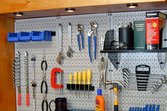 Versatile pegboard provides easy and inexpensive storage solutions for virtually any room and under-utilized wall space.
Pegboard comes as either tempered hardboard panels or metal sheets.
Hardboard panels are ¼-inch thick and feature ¼-inch diameter holes, evenly spaced 1 inch apart across the face of the entire sheet. Hardboard pegboard panels are easy to cut into custom shapes for fitting odd-shaped areas.
Hardboard pegboard comes in standard sizes (2×4-foot, 4×4-foot, and 4×8-foot sizes); commonly available colors are natural, black, and white. Latex paint color can also be rolled on.
Hardboard panels are lightweight and affordably priced; expect to pay $8 to $50 for a 4×8-foot panel.
Metal sheets come in several types of metals and weights. Some feature slots, rather than holes, to accommodate specialized accessories, such as bins and shelves. Metal pegboard sheets are durable and the perforations never lose their shape. Properly installed heavy-duty versions support up to a ton of items.
Metal pegboard sheets come in a variety of patterned and smooth finishes, and a variety of anodized colors. Standard sheet sizes are the same as hardboard, plus 16×32-inches and 4×10-foot panels. Cost: $33 to $400.
Accessories: Standardized perforations accept a wide range of hooks, clips, shelves, bins, racks, jars, and other storage accessories that you can arrange and rearrange to suit your changing needs. Use them to organize any combination of household tools, supplies and belongings. Cost: 30 cents to $15 each.
 Real Estate and *stuff *