Real Estate and *stuff *
A real person helping real people with real estate
You can scroll the shelf using ← and → keys
You can scroll the shelf using ← and → keys
 Through the end of the year there is a $25 rebate available on programmable thermostats purchased at Home Depot! You can use the rebate to purchase the $25 Honeywell Model (here) or put it towards a more sophisticated model.
Limit two per household but that’s a $50 savings to set your winter temps! Click here for the rebate.
(Special thanks to my clients “The Handsome Dan’s” for this helpful information!)
Space heaters used to be clunky plugins that squatted on the floor and scared the fluff off your cat. No more — these 5 space heaters are totally cool.
 This radiant heat panel — the mirror and towel bar on the left — is so integrated into this bathroom that you may not even notice it. Image: Warmly Yours
You’ve probably heard of radiant heating for floors, created by snaking heating tubes or cables under floors. But that’s not the only application for this efficient, quiet method of heating. Manufacturers now produce radiant panels for walls, ceilings, and other locations.
Radiant heat, also known as infrared radiant heat, is especially efficient, heating solid objects such as chairs and people without heating the air. The warming effect of radiant heat is practically instantaneous, and solid objects store the heat and stay warm even after the system switches off.
(Forced-air heating does the opposite, heating the air first, which then eventually warms people and surfaces. When a forced-air system shuts off, temperatures fall rapidly.)
Radiant panels come in many sizes, from a couple of square feet to 30 square feet and larger. Because no heat is lost in air ducts (there aren’t any), radiant panels are especially energy efficient, and the use of supplemental radiant panels to selectively heat rooms helps reduce annual energy costs by 10% to 30%.
 Finding the best heating solution for a specific situation is a fine art — sometimes literally. A thin-film, infrared radiant panel made by Prestyl USA hangs on a wall and looks just like artwork, custom-printed with a design or photo you submit.
“We just need a digital high-pixel image that you have the rights to,” says the president, Thom Morrow. “So no Seattle Seahawks logos. But a portrait of the family, fine. Or dog or horse or the old family farm.”
These plug-in art panels project out from the wall just 1½ inches. Inside is a carbon-based material that absorbs energy when current passes through. The panel then releases the energy as infrared light waves.
An artistic panel isn’t cheap, but you can take into account what you might spend on equivalent artwork. Prestyl’s plain 2-by-2-foot panel, suitable for an 8-by-10-foot room, costs $352, plus $180 if you want an image, or a total of $6.65 per square foot of living space.
 If you heat with electricity and live where electrical rates are lower at off-peak hours, an electrical thermal storage heater could save you money.
This kind of heater consists of a well-insulated shell filled with ceramic bricks that efficiently absorb and store heat. The bricks heat up during hours when power rates are low, then release the heat, using a blower, when the rate rises, potentially saving you hundreds of dollars a year.
Al Takle, national sales manager for Steffes Corp., says the units only make sense where rates dip for part of the day. Where’s that? He listed:
Thermal storage heaters sit on the floor and are about 12 inches deep, 24 inches high, and 30 to 60 inches long. They require only a little clearance on sides and the top, so you can easily build them into bookcases or window seats. Costs range from $1,200 (for a small bedroom or office) to $2,200 (for a 1,000-square-foot, open living room and kitchen space), or $2-$12 per square foot of living area.
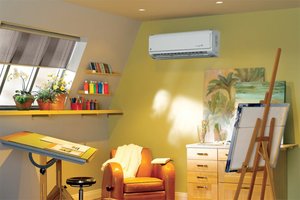 If you’re looking to retrofit an older home that doesn’t have ductwork, or you’re adding on and tying into your existing HVAC system is problematic, a ductless heat pump could be the answer.
Developed in Japan 30 years ago, many heating contractors in the U.S. are just now learning about this option, also known as a mini-split. There are only two main components: an outdoor compressor unit and an indoor air handler, which is typically installed high on an outside wall.
A small tube delivers conditioned air directly to the room. Because there’s no long expanse of ductwork, ductless heat pumps operate up to 50% more efficiently than traditional forced-air systems.
The installed price is around $5,000 for equipment that handles 1,100 square feet, or $5.45 per square foot of living space. Many power companies offer rebate incentives, sometimes for as much as $1,500, to customers who switch from other kinds of electrical heating.
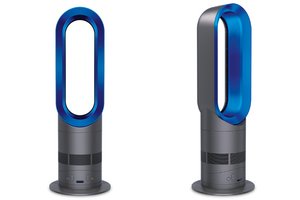 For a floor-model space heater that’s out of this world, look to Dyson — the company that seems to delight in reinventing ordinary household items.
The Dyson Hot fan heater looks like a space creature that never got around to developing a face. It generates heat like any other electrical-resistance heater, but there’s no visible whirling fan, so you don’t have to worry about whether a curious kid will stick in a finger to see what happens.
Even though you don’t see a fan, the heater does blow out a steady stream of warm air. The heater pushes air over its curved surfaces to increase output, much the same way an airplane wing accelerates air flow. The fan head oscillates, and you can tilt the device to direct the air flow.
The Hot fan costs $400 and is suitable for small to medium-size rooms, or about $4 per square foot of living space for a 10-by-10-foot room.
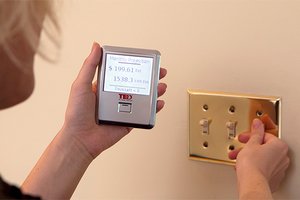 Energy monitors make managing your power consumption enjoyable and easy to do. And we’re using energy today! BRR!
Researchers have shown that the well-known hybrid car saves energy for two reasons: It efficiently uses both gasoline and electric power, and it also provides a display screen that lets drivers track their real-time MPG efficiency.
Various environmental reports have suggested that home-based energy monitors have the same effect–keeping an eye on the display screens encourages savings of up to 10% of a home’s heating and cooling costs.
Energy usage monitors are readily available and affordable. A system like TED–The Energy Detective ($120 to $455)–has a measuring unit connected to your home’s circuit breaker panel. Data, such as energy consumed in watts and dollars, is sent to another unit called the Gateway, which delivers energy usage info to your computer or wireless dashboard. TED stores up to 10 years of data.
Similar systems are available from Blue Line ($100) and the upcoming EnergyHub.
Utility companies are starting to replace analog electricity meters with digital smart meters that offer two-way communication, allowing utilities to regulate energy distribution more effectively. Smart meters transmit info via a secure radio frequency network so that utility workers don’t have to brave growling dogs and muddy side yards to read your meter.
If your home is one of the early adopters, you can track your hourly energy usage through your utility’s web-based application. That way, you can discover when in the day is electricity the cheapest, and schedule laundry and other power-hungry tasks for that time. In addition, your utility can send you a detailed electricity bill instead of an estimate of charges.
Smart meters also can transmit data to indoor display units that work like off-the-shelf energy usage monitors. A smart meter also can include details on gas usage.
Note that smart meters require professional installation by your utility, so call to find out if your home is on their roadmap.
If you want more use out of the real-time data, Google’s free PowerMeter is an advanced web-based graphical application that works with your home’s smart meter or energy monitor to track usage over time, set energy savings goals, and predict your energy bill based on usage.
The software can help you tailor your usage to bring down costs. It’s available through devices such as TED and utility companies such as San Diego Gas & Electric.
If outfitting your entire home for energy monitoring isn’t feasible, you can still track the energy use of household items with the small, portable Belkin Conserve Insight ($30). It can tell you an appliance’s usage in dollars, carbon dioxide emitted, and watts consumed, and it offers monthly and yearly estimated costs.
Similar devices from Kill A Watt EZ include an energy usage monitor power strip, and range from $16 to $60.
 Real Estate and *stuff *