Real Estate and *stuff *
A real person helping real people with real estate
You can scroll the shelf using ← and → keys
You can scroll the shelf using ← and → keys
 In a rush to claim the home owner tax benefits Congress reinstated? Not so fast. The IRS isn’t ready to accept your tax returns.
Congress’s down-to-the-wire fiscal cliff deal on tax changes, which included some goodies for home owners, has put the IRS behind the eight ball. It’s scrambling to create new tax forms and modify old ones to reflect the tax code changes.
So if you’re raring to collect your due (and you’re eligible to), time to get Zen and sit tight.
In case you missed it, Congress resurrected:
So that’s the cool part. Now for the paperwork part.
What Kind of Delays are We Talking About?
The IRS was planning to have the 1040 — the workhorse form pretty much all of us have to fill out — on its website by Jan. 22. But now, it’s going to be Jan. 30. That means you can’t file your return until Jan. 30. It doesn’t matter if you file online or with paper — as far as filing is concerned, the IRS is closed for business until Jan. 30.
Still, that’s just over a week, and the various records you receive from banks, brokerages, and employers might not be ready until the end of January anyway. So it’s not a biggie.
But if you’re claiming the energy credits with Form 5695, you’ll have to wait longer. The IRS doesn’t even know when that form, along with many others, will be available. End of February? Beginning of March? Stay tuned.
Regardless, you should still be able to meet the April 15 deadline.
For now, gather your paperwork, such as proof of any credits you’re entitled to, so when the IRS is ready, you are, too. And check with your tax pro or customer service department of the software you use to make sure they’re up to speed as well.
Tired of pinching pennies? Weary of the recession? Dream along and pretend we can afford these top-shelf home improvements. But don’t worry if these budget-stretchers are out of reach — we’ve got you covered with smart advice for alternative products and systems that will make you feel luxurious without draining your bank account.
 Throw the switch on your very own wind turbine and you’ll get a 50% to 90% reduction on your electrical energy bills. The price of all this efficiency is about $40,000 for a 10-kilowatt turbine, a steel tower, and professional installation. If that’s not in your budget right now, a little regular maintenance will keep the HVAC system you have running at peak efficiency. Credit: Bergey Windpower Company
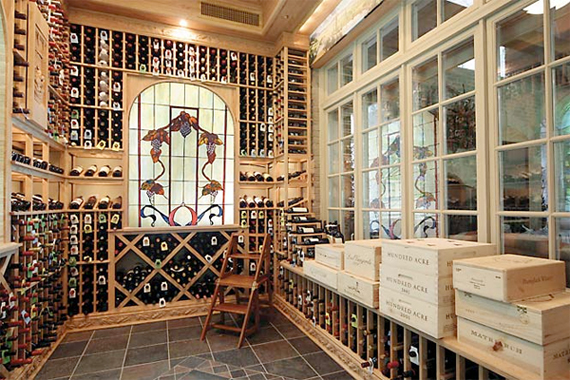 Wine connoisseurs know that the beverage itself is only part of the fun — a glass-front, temperature-controlled wine cellar adds to the delight. For wine aficionados who collect as well as sip, storage is a must — the wine cellar shown here holds 1,346 bottles. Ceramic tile floors, hand-carved trim, stained glass, and lighted racks add up to a $70,000 taster’s haven. If your storage needs are more modest, check out under-stairs storage solutions that gobble up clutter. Credit: Wood wine racks by Wine Cellar Innovations
 Stoves from La Cornue are known as some of the world’s most elegant cooking appliances. Each is handmade, and can be ordered as gas, electric, or a combination of both. Choose from 25 enameled finishes and 12 metallic trims. The GrandPalais 180 model features dual ovens and retails around $45,000. For that, you could buy a dozen top-of-the-line, double wall ovens with options that include convection heat, temperature probes, and variable broiling. Credit: Culinary Architecture by La Cornue
 With an insulated glass panel that lets you check contents before opening the door, the stylish Sub-Zero Pro48 is billed as one of the most expensive — and best — refrigerators on the market. Listed at a cool $15,540, the Pro48 features an LCD touch-pad that controls two compressors and three evaporators. Be sure to green clean the inside of your Pro48 so that it’s nice and tidy if guest should peer through the window. Credit: Sub-Zero
 Nothing quite says “welcome” like a pair of custom-designed, hand-carved entry doors made of pine, mahogany, or oak. Expect to pay $5,000 to $25,000 for a matched set of custom-made, double-opening exterior wood doors, installed. The price may be worth it: A good-looking exterior door is a big contributor to curb appeal, and helps preserve the value of your home. Credit: Pinecrest, Inc.
 If your little slice of heaven is racking up heating and cooling costs, consider a geothermal heat system. A geothermal heat pump system extracts heat and cooling from deep underground to keep your interiors on an even keel, reducing energy usage. The price for a geothermal system can be steep — typically $20,000 for a 3,000-sq.-ft. house. The good news: A system placed in service between Jan. 1, 2009, and Dec. 31, 2016, is eligible for a 30% federal tax credit. Credit: Colorado Geothermal Drilling
 Slate shingles were once common, but modern roofing, such as asphalt shingles, have become so much more cost-effective that slate is increasingly rare — and expensive. According to Remodeling Magazine’s Cost vs. Value Report, covering a 3,000-sq.-ft. roof with top-quality asphalt shingles costs about $21,000. A comparable slate roof costs $100,000 to $150,000. Nevertheless, if you want a roof that’s classy, fireproof, and will last 100 years or more, slate is hard to beat. Credit: Linda Hartong
Now dream of sugar plums…it’s Christmas time after all!
 What is a Form 5695?? Your energy tax credit! This is a great tax credit that encourages energy upgrades in our homes. Sidestep snares in the complex IRS Form 5695 to get all the 2010 energy tax credits you’ve got coming.
What type of system did you install? If it’s one of the following, complete Part 1 for Nonbusiness Energy Tax Credits.
Max credit: 30% of the cost of the improvement, up to $1,500.
If you installed one of these souped-up systems, complete Part 2 for Residential Energy Efficient Property Credit.
Max credit: 30% of the cost, with no limit except for a kilowatt limit on fuel cells.
For Part I, it’s pretty simple: Just enter the total of all this part’s credits (as shown on line 11) on Form 1040, line 52.
For Part II, it can get complicated because other credits, claimed on other forms, can affect the amount of your Part II credit.
If you need to fill out any of the following forms, have all the information needed to complete those at hand, because Form 5695, line 25, coordinates with all of them. (In fact, you’ll find it simplest to prepare all these forms more or less simultaneously.)
One form that’s irrelevant to completing 5695: Schedule A. That’s only for deductions, not credits. And you don’t even need to itemize to claim energy tax credits.
You’ll find many places you can go wrong in both parts of the form:
Adding ineligible amounts into the form. Just because a product has an Energy Star label doesn’t mean it’s eligible for a credit. Check the details of what’s eligible for the credit and what’s not at Energy Star and make sure the product comes with a manufacturer’s certification.
Failing to keep track of this year’s energy tax credits for future years. Hang on to your tax credit paperwork (including receipts, certifications, and a copy of your completed Form 5695), because if you sell your house you’ll need to record the tax credit amount for tax purposes.
Failing to file this form at all—or only partially. If you’re eligible for a lot of different tax credits, you can conceivably reduce your tax liability to zero. If that’s the case and you want to tack on the 2010 energy tax credit, you’re out of luck. The feds consider it nonrefundable. If it were a refundable tax credit, the IRS would write you a check.
Forgetting certain credits that affect Part II—and vice-versa. Pay special attention to line 25: Certain other credits may ultimately affect your ability to fully claim Part II credits—just as Part II credits may affect other credits. Follow the line-by-line instructions in each form carefully. It’s easy to forget a number here.
If you find Form 5695 exasperating, you may be eligible for free tax preparation help from the:
Major tax preparation software, such as TurboTax, include this form in their packages.
 Real Estate and *stuff *