Real Estate and *stuff *
A real person helping real people with real estate
You can scroll the shelf using ← and → keys
You can scroll the shelf using ← and → keys
 Solar Christmas lights don’t cost anything to operate, but the high purchase price might not add up to savings.
In the last few years, energy-efficient LED Christmas lights have largely replaced more wattage-thirsty incandescent strings, resulting in significant savings — LED lights use 70% less energy than their incandescent predecessors, and they last up to 10 times longer as well.
Now there’s a new kid in the string-light neighborhood: LED solar Christmas lights are appearing at retailers around the country, promising grid-free festive lighting for holiday-happy consumers.
Powering up solar Christmas lights
A string of solar Christmas lights uses a small solar panel for power; there are no extension cords that must be plugged into outlets. The panel — about the size of a hockey puck — powers rechargeable batteries that illuminate a 25- to 100-bulb string of LED lights.
Panels come with small stakes so you can put them in the ground, where they can take advantage of the sun. A fully-charged string of lights should glow for 6 to 8 hours after the sun goes down.
Solar lights vs. LED plug-in costs
Most consumers expect new technologies to cost more, but if saving energy and money is your main reason for considering solar-powered LED holiday lights, solar lights may not offer enough cost-saving to offset the higher initial purchase price.
Compare purchase prices:
Compare costs to operate:
Do the math, and you’ll see that it’ll take about 45 years for the energy savings from solar-power to equal the difference in purchase price between a plug-in string and a solar-powered string.
Advantages of solar lights
Disadvantages
Tired of pinching pennies? Weary of the recession? Dream along and pretend we can afford these top-shelf home improvements. But don’t worry if these budget-stretchers are out of reach — we’ve got you covered with smart advice for alternative products and systems that will make you feel luxurious without draining your bank account.
 Throw the switch on your very own wind turbine and you’ll get a 50% to 90% reduction on your electrical energy bills. The price of all this efficiency is about $40,000 for a 10-kilowatt turbine, a steel tower, and professional installation. If that’s not in your budget right now, a little regular maintenance will keep the HVAC system you have running at peak efficiency. Credit: Bergey Windpower Company
 Wine connoisseurs know that the beverage itself is only part of the fun — a glass-front, temperature-controlled wine cellar adds to the delight. For wine aficionados who collect as well as sip, storage is a must — the wine cellar shown here holds 1,346 bottles. Ceramic tile floors, hand-carved trim, stained glass, and lighted racks add up to a $70,000 taster’s haven. If your storage needs are more modest, check out under-stairs storage solutions that gobble up clutter. Credit: Wood wine racks by Wine Cellar Innovations
 Stoves from La Cornue are known as some of the world’s most elegant cooking appliances. Each is handmade, and can be ordered as gas, electric, or a combination of both. Choose from 25 enameled finishes and 12 metallic trims. The GrandPalais 180 model features dual ovens and retails around $45,000. For that, you could buy a dozen top-of-the-line, double wall ovens with options that include convection heat, temperature probes, and variable broiling. Credit: Culinary Architecture by La Cornue
 With an insulated glass panel that lets you check contents before opening the door, the stylish Sub-Zero Pro48 is billed as one of the most expensive — and best — refrigerators on the market. Listed at a cool $15,540, the Pro48 features an LCD touch-pad that controls two compressors and three evaporators. Be sure to green clean the inside of your Pro48 so that it’s nice and tidy if guest should peer through the window. Credit: Sub-Zero
 Nothing quite says “welcome” like a pair of custom-designed, hand-carved entry doors made of pine, mahogany, or oak. Expect to pay $5,000 to $25,000 for a matched set of custom-made, double-opening exterior wood doors, installed. The price may be worth it: A good-looking exterior door is a big contributor to curb appeal, and helps preserve the value of your home. Credit: Pinecrest, Inc.
 If your little slice of heaven is racking up heating and cooling costs, consider a geothermal heat system. A geothermal heat pump system extracts heat and cooling from deep underground to keep your interiors on an even keel, reducing energy usage. The price for a geothermal system can be steep — typically $20,000 for a 3,000-sq.-ft. house. The good news: A system placed in service between Jan. 1, 2009, and Dec. 31, 2016, is eligible for a 30% federal tax credit. Credit: Colorado Geothermal Drilling
 Slate shingles were once common, but modern roofing, such as asphalt shingles, have become so much more cost-effective that slate is increasingly rare — and expensive. According to Remodeling Magazine’s Cost vs. Value Report, covering a 3,000-sq.-ft. roof with top-quality asphalt shingles costs about $21,000. A comparable slate roof costs $100,000 to $150,000. Nevertheless, if you want a roof that’s classy, fireproof, and will last 100 years or more, slate is hard to beat. Credit: Linda Hartong
Now dream of sugar plums…it’s Christmas time after all!
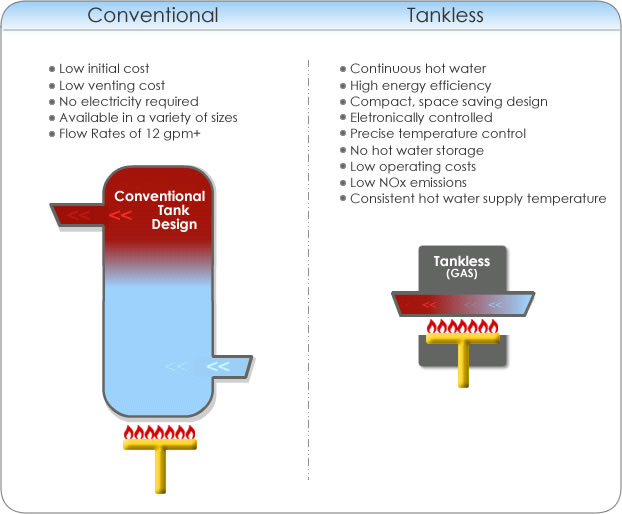 If you’re a hot water multitasker who washes clothes, dishes, and yourself at the same time, a low-capacity tankless water heater could serve you a “cold water sandwich” or leave you high and dry. But tankless water heaters, which heat water only on demand, are more energy-efficient than traditional water heaters, which warm water whether you need it or not. What’s the best way for you to get into hot water? Read on.
Traditional vs. tankless water heater
Traditional hot water heaters typically live in your basement and provide gallons of hot water at one time: an 80-gallon tank heats enough water to shower, run a dishwasher, and do a load of laundry simultaneously. But standby energy loss is significant with hot water heaters, and once you’ve exhausted the hot water supply, you’ll wait 20 to 60 minutes for the heater to cook up more.
A tankless water heater produces hot water only when you need it. When you turn on the faucet, water is heated on the spot as it flows through capillary-like pipes heated by either a powerful gas burner or electric coils. (There are no oil-fired on-demand water heaters on the market.)
Gush to a trickle
Although a tankless water heater can pump hot water all day, it can’t produce a large amount all at once. And it can snap you out of a hot shower bliss with the “cold water sandwich effect,” a sudden splash of cold water that results from turning the hot water faucet on and off repeatedly.
A traditional tank heater puts out 7.5 to 9.5 gallons of water per minute (GPM), enough to shower, run the dishwasher, and do a load of laundry all at the same time. The typical tankless water heater, however, puts out only 2.5 to 5 GPM, enough to handle only two uses at a time.
Be warned: Not all flow rates are calculated the same. Energy Star measures GPM based on a 77-degree increase in water temperature for the incoming supply, while some companies list their GPM flows at 35- and 45-degree rises. The more heat the water requires to reach the desired temperature, the slower the flow rate.
High upfront costs
A gas-fired tankless water heater system costs $1,500 to buy and install, nearly double the price of a conventional gas water heater, and $575 more than a high-efficiency tank model. In addition, while a conventional water heater typically uses a half-inch gas line, a tankless water heater requires three-quarter-inch pipe. That plumbing change costs from $25 to $40 a foot, potentially adding many hundreds to initial costs. On the bright side, your new energy-efficient unit may qualify for a federal tax credit of up to $300 on purchase and installation through 2011.
An electric tankless water heater costs as little as $400 installed. But it doesn’t qualify for a tax credit because it is less efficient than gas and is better suited for point-of-use applications, such as instant kitchen hot water, rather than a whole-house system.
Installing multiple units
One solution to the limited output problem is to install multiple on-demand units. Because it’s small—about the size of a carry-on suitcase—you can place a tankless water heater along any stretch of pipe—in the attic, basement, closet, or crawlspace. You can install two or three units to serve different parts of the house, or even dedicate a unit for a particular use, say a washing machine.
Multiple on-demand units increase overall energy efficiency. By bringing hot water close to where it’s needed, you reduce energy loss and increase efficiency by 50% over a conventional hot water tank system, about $165 in annual savings for an average household.
Energy and money savings
 Washington is giving you less green for going green, as the feds reel back the 2011 energy tax credits from a lavish $1,500 to a paltry $500.
2011’s federal energy tax credits of up to $500 for various home improvements are a far cry from what they were last year. But if the limits and other fine print—which we’ll get to—doesn’t dissuade you and you really need to upgrade one or more of the following systems, take advantage of the energy tax credits.
The energy tax credits are small, but at least a credit is better than a deduction:
Other limits on energy tax credits besides $500 max
Certain systems capped below $500
No matter how much you spend on some approved items, you’ll never get the $500 credit—though you could combine some of these:
| System | Cap |
| New windows | $200 max (and no, not per window—overall) |
| Advanced main air-circulating fan | $50 max |
| Qualified natural gas, propane, or oil furnace or hot water boiler | $150 max |
| Approved electric and geothermal heat pumps; central air-conditioning systems; and natural gas, propane, or oil water heaters | $300 max |
And not all products are created equal in the feds’ eyes. Improvements have to meet IRS energy-efficiency standards to qualify for the tax credit. In the case of boilers and furnaces, they have to meet the 95 AFUE standard. EnergyStar.gov has the details.
Tax credits cover installation—sometimes
Rule of thumb: If installation is either particularly difficult or critical to safe functioning, the credit will cover labor. Otherwise, not. (Yes, you’d have to be pretty handy to install your own windows and roof, but the feds put these squarely in the “not covered” category.)
Installation covered for:
Installation not covered for:
How to claim the 2011 energy tax credit
 If you like to get your money’s worth by squeezing every ounce from a tube of toothpaste, you’ll be happy to know it has many other uses around the house besides cleaning your teeth.
What MacGyver did:
Used plastic explosives disguised as toothpaste to create a diversion, allowing him to disarm his captor.
What you can do:
 Get yourself out of a home repair jam with this common household item famously used by our favorite handy hero: MacGyver.
We’ve all had them: the clogged drain, the ripped vacuum hose, the unsightly hole in the wall. Home repair emergencies like these are the last thing you need when you’re running out the door, running after the kids, or fielding other household chores. Channel your inner MacGyver by taking advantage of one common household item the classic action hero made famous: a roll of duct tape.
What MacGyver did:
Used duct tape to seal a hole in a hot air balloon, allowing him to escape his pursuers.
What you can do:
Who doesn’t love a good MacGyver episode??
 Looks like Steve Jobs was an iconoclast when it came to homes and kitchens, too.
Although Americans lately have embraced smaller homes, shrinking their average size by 5% from 2007 to 2010, Jobs thought smaller was better even 18 years ago, according to British kitchen designer Johnny Grey, who worked with Jobs in the mid-1990s. (See Johnny Grey’s blog on the kitchen design)
“Remarkably, for one of the world’s richest individuals, Jobs lived in modest style,” says Grey about the Palo Alto home that Jobs and his wife, Laurene, called their “cottage.” The center of family life was a cozy kitchen with white cabinets, tiled tops, and wooden edges.
Grey and Jobs worked together on a kitchen design that was contemporary and compact.
“Shaker simplicity was often his default position,” Grey says. “I suspect he became more of a modernist in the late nineties.”
Unfortunately, Jobs never constructed the kitchen.
“He was a very private person and reluctant to have contractors work around him,” Grey says, “powerfully disliking noise, mess and invasion of their home.”
Do you have any memories of Steve Jobs? Have you ever designed a project that you didn’t construct?
 If a neighbor’s tree falls over your property line, file an insurance claim for repairs and cleanup. No house damage? Check if chopping and hauling debris is covered.
When a tree falls
Your neighbor is responsible when a tree falls over your shared property line only if you can prove he was aware that his tree was a hazard and refused to remedy the problem. Regardless, your insurance company restores your property first, and later decides whether or not to pursue reimbursement from the neighbor or his insurer if the neighbor was negligent in maintaining the tree.
Before a tree falls
Write a letter to your neighbor before his dead, diseased or listing tree falls through your roof or over your property line.
The letter should include:
Trim their trees
If the limbs of a tree hang over your property line, you may trim the branches up to the property line, but not cut down the entire tree. If a tree dies after your little pruning, the neighbor can pursue a claim against you in civil or small claims court. Depending on the laws of your state, your neighbor may have to prove the damage was deliberate or caused by negligence, but may also be able to recover up to three times the value of the tree.
Before you cut, tell your neighbors what you intend to do to protect your property. They may offer to trim the whole tree instead of risking your half-oaked job.
Your tree falls
It’s always a good idea to take care of your big and beautiful trees, and keep receipts for trimmings and other care.
But if your tree falls over a neighbor’s property line, do nothing until their insurance company contacts you. You may not be liable unless you knew or should have known the tree was in a dangerous condition. If you pruned a tree or shored up trunks to prevent problems, gather your receipts to prove your diligence.
I just had to do something fun today with all this winter snow/no power stuff! We’ve all seen them, lurking around the corner, maybe in the next neighborhood: houses with unaccountably strange paint jobs. As entertaining as they are to look at, odd ducks like these might deter future buyers and tend to lower property values of nearby homes. Check out these extreme exteriors to learn how your home’s fresh coat can look good and preserve the worth of your home and neighborhood.
 The exterior of your house says a lot about you. But even if you have the most exuberant personality on your block, you still have an obligation to fit in with your neighbors. This is especially true if your property is part of a home owners association — an HOA. Most HOAs have strict rules about the style of your house, your choice of paint colors, and other criteria that help preserve the property values of nearby homes.
Credit: Joanne Teh/Flickr
 Choosing great exterior colors means selecting body, trim, and accent colors that complement each other. If chartreuse and salmon are your idea of a cool combo, you’d be wise to check out an app like ColorSnap from Sherwin-Williams. Take a photo of your property, and ColorSnap suggests harmonious color combinations for your house. The free app is available for iPhone, Android, and Blackberry.
Credit: Chad Miller/Flickr
 Painting foundation walls neutral colors emphasizes the body color of your siding — hopefully that’s a good thing. Rough-textured concrete block and poured concrete foundation walls are tricky to paint, and finishing them is a time-consuming project. Use an exterior paint formulated for concrete and masonry.
Credit: John Boyd/Flickr
 Artist Peter Kaschnig certainly was in his blue period when he painted this entire house in Klagenfort, Austria, a royal azure. While Kaschnig managed to cover every nook and cranny with blue paint — including roofing and windows — he spilled nary a drop on the surrounding lawn, thanks to proper use of tools and drop cloths.
Credit: Paul Ott photo/Blue House — Peter Kaschnig
 If you want to green up your exterior paint job, selecting bright green paint isn’t exactly what we had in mind. Get with environmentally friendly techniques by selecting low-VOC paints and recycling your used paints and stains.
Credit: Eric Allix Rogers/Flickr
 If you lived here, you wouldn’t have much trouble finding your house, day or night. Keep your polka dots bright with regular maintenance that includes cleaning your siding, repairing cracks and damage promptly, and refinishing with high-quality exterior paints and stains.
Credit: Michelle Figurski (photo)/Tyree Guyton/Heidelberg Project
 Whatever the color, the abandoned, horror movie look is never inviting. But before you start sanding and scraping, test for the presence of lead paint. If your test is positive, read up on lead paint laws that describe how to deal with the problem safely.
Credit: AD Gimenez
 Multiple colors are eye-catching but spell trouble when it comes time to repaint. To reduce ongoing maintenance, choose a base color and one or two trim colors that simplify repainting. Top-quality exterior paints may cost more initially but will pay for themselves in reduced upkeep costs over the years.
Credit: © PJ Taylor Photography, 2008
 With its dark red door, black shutters, and crisp white trim, this Colonial house has a classic color scheme — unless you factor in that dash of marketing bling on the siding. No matter what color or message says “pride of ownership” to you, you’ll get the best results using the right painting tools, brushes, and rollers.
Credit: Adzookie Inc.
Would you paint your house in any of these extreme ways? I admit…I just might!
 The Farmers’ Almanac is expecting some “clime and punishment” this winter, much like the October surprise snow storm that’s knocked out power to 3 million homes. Here’s how to prepare for the next big weather hit.
Last week’s surprise snowstorm, which left 3 million people without power from Maryland through Maine, is just the beginning of what the Farmers’ Almanac is predicting to be an unusually cold and stormy winter.
That could mean many days without power. So if you haven’t already bought a portable generator, now’s the time to purchase one at your local home center. And if you own a generator, gas it up, because you never know when the next snow dump will knock out electricity.
Also, investigate whether a whole house generator is right for your home. They can be pricey — on average $14,700 — but going a week or more without electricity costs you, too.
Finally, don’t forget to make a home emergency preparedness kit with everything from water and food to flashlights and cash.
Did you lose power in the weekend storm? How did you get by?
 Real Estate and *stuff *