Real Estate and *stuff *
A real person helping real people with real estate
You can scroll the shelf using ← and → keys
You can scroll the shelf using ← and → keys

Casings are the moldings that go around the window frames. They are installed outside the house to seal the window frame to the house blocking cold air from entering the interior.
Inside, casings are the finishing touch to a window installation, the same as baseboards and door moldings finish off a room. They generally match the same moldings used in those applications so the room has a cohesive look. Outside, casings match the style of the home so there are countless designs to choose from.
Traditional homes tend to have simple casings flanked by shutters on the sides. Victorian-style homes might feature thicker and more elaborate carved designs in keeping with the gingerbread look that often appears on these types of homes.
Here are the most common types of casings.
Moldings that surround all four sides of your windows are often called complete casings. They can be a simple layer of molding or multiple layers made up of stacked moldings that trim out the windows, making them appear more decorative and appealing. Interior casings often match or complement the interior moldings inside the rest of your house.

Mostly utilitarian rather than decorative, a low-profile casing that lays flat against the siding of your house or the interior walls lends a finished look and helps visually tie the window to the house. It blocks cold air from entering the house and keeps warm, heated air inside the house.
Simple single-layer casings cost about $5 per foot.

These types of casings offer the most options. They can either surround the entire window or sit as a pediment above the window. Many companies now offer plastic or composite materials that are ready-made and offer the look or layered moldings without the carpentry skills needed to construct a layered look.
These one-piece casings can be combined to beef up the look. They look especially fitting on classic homes, like traditional and Victorian styles.
Costs vary, but they generally run about $10 per foot for basic styles. More elaborate layered looks and combinations up the cost.
Minimal and clean lined, modern casings often match the color of the wood or material of the rest of the window, blending in rather than standing out. On modern homes, the glass takes center stage in the design of the windows rather than the moldings.
Costs run from about $1 to $5 per foot.
Simple in style, traditional casings are similar to low-profile casings in that they generally suit older homes and lay flat against the exterior and interior walls. They can be made up of a single layer of wood or composite material and often sport a simple design, such as a simple stool molding supported by an apron along the bottom of the window, a slightly protruded header molding and perhaps a more decorative or fluted column design flanking the window frame.
Costs vary but expect to pay about $1 to $5 per foot for this type of casing.
 These stair treads are MDF covered in stained brown paper, giving the overall effect of cork. All images in this post: Rachael from Lovely Crafty Home
When I first saw pictures of Rachael Evans’ stairway upgrade, I honed in on the textured wallpaper she applied to the risers beneath what looked like cork treads.
But as I read Rachael’s post, I realized the treads were not cork or burled wood. They were MDF covered with stained brown paper — a decoupage technique that made the plain treads look expensive and elegant. It’s faux flooring for less than $100.
Brown-Paper Stairs 101
This time-intensive but low-cost refinishing technique requires:
Rachael has printed a complete tutorial on how to lay down brown paper flooring. Here’s the basic process.
1. Remove carpet and padding.

2. Tape off baseboards to protect the paint.
3. Tear paper into 6- to 12-inch-diameter pieces; the smaller the pieces, the more leathery the floor will look. (Pieces with straight edges are good for applying next to walls.) Crumple into balls and toss into a contractor’s plastic bag until you need them.
4. Dilute glue with water using a ratio of 3 parts water to 1 part glue. Only dilute enough glue to use in one session.
5. With a paintbrush, brush treads with undiluted glue.
6. Dunk 5-6 balls of paper at a time into the diluted glue; squeeze out excess.
7. Lay paper on treads, overlapping a little. Brush the diluted glue mix over the paper to flatten and remove wrinkles.
8. Allow to dry for about 12 hours.
9. Apply stain, and let that dry for 48 hours.
10. Apply 12 coats of water-based polyurethane, sanding lightly between coats.
Wallpaper Risers
Once you’ve finished refinishing the treads, you can refresh the risers by applying paintable textured wallpaper. Rachael used an embossed print called anaglypta ($20 for 22 sq. ft.), which looks like vintage metal ceiling tiles.
To give the project a finished look, she glued a piece of trim onto the bottom of each riser.

Lessons Learned
1. Work on every other stair, so you can use the stairway while you’re refinishing. The project will take four days to complete, so you don’t want to be without your stairway for that long.
2. For best results, practice the technique on scrap wood before trying it on the stairs.
3. For a light, natural color, skip the stain.
4. Allow everything to dry completely before proceeding to the next step. Patience is key to good results!
Thank you Rachael!

Uploaded with ImageShack.us
There’s a gap in your home that’s wasting precious energy and inviting cold air inside — do you know where it is?
Have you caulked windows and replaced weather stripping on your doors? Good for you. But if you think you’ve sealed up air leaks, you’re in for a shock.
The biggest air leak in your home is right under your nose.
Or, underfoot, more accurately.
 It’s the hole that a plumber cuts in the subfloor to make room for the drain assembly at the bottom of a bathtub. Because the drain assembly is big, plumbers make way for it by cutting a generous-size hole that gives them some “wiggle room” when connecting plumbing pipes. This big hole often is left open to the space below.
If you have a first-floor bathroom over a crawl space or unheated basement, you likely have one of these giant energy wasters in your home“Having that big hole for the bathtub drain can waste about as much energy as leaving one of your windows open a few inches, all day, every day,” says Allison Bailes III, president of energy consultant firm Energy Vanguard. “The main difference is that you can easily close the window, but most people don’t even know about this other open window.”
And BTW, that hole also is big enough for good-size critters to crawl inside your home!
Plumbers may plug this hole with a wad of loose insulation, but that’s an imperfect solution — fiberglass insulation can sag over time, especially if it gets damp. The preferred method is to insert foam board that’s cut to fit around the pipes, then seal the board in place with spray foam insulation.
You won’t know if you have a problem unless you crawl under your bathroom and take a look at the tub drain assembly from underneath. Patch the hole with pieces of foam board screwed in place, then seal any gaps with spray foam insulation ($8/can).
A plumber will do the job, too, but that’ll set you back $100-$150. Probably worth it when you think about energy savings, comfort, and keeping mice and camel crickets out of your house!
Everything but the kitchen sink? No wonder — it gets so much use, that’s the last thing you’d ever toss!

This multi-faceted model is a kitchen wizard. Optional strainers, colanders, cutting boards, and drain racks let you reconfigure and adapt this stainless steel sink to whatever task is at hand.
Type: Self-rimming drop-in
Material: 16-gauge stainless steel
Cost: $1,900 to $3,800, depending on accessories
Credit: Elkay

Big, deep soapstone sinks that harken to the days of Frank Lloyd Wright are making a comeback. Nearly impervious to stains and heat, soapstone requires only an occasional swipe of mineral oil to retain its beauty. It’s so dense that it won’t harbor bacteria, either, making it easy to clean. Save money and buy a used one where salvaged building materials are sold.
Type: Extra-deep (16 inches) apron-front
Material: Soapstone
Cost: $1,500 to $3,000
Credit: JAS Design Build / Vista Estate Imaging
 Environmentally-Friendly Sink
This rustic double-bowl sink is made from molded magnesium oxide, a type of ceramic cement. Eco-wise, it trumps regular Portland cement with low embodied energy (it requires less energy to manufacture) and its ability to absorb carbon dioxide that contributes to global warming. A good choice for green kitchen remodeling.
Type: Integral (formed seamlessly into the countertop)
Material: Magnesium oxide
Cost: $125 per sq. ft. for the countertop, add $2,500 for the sink
Credit: Lithistone Double Integral Kitchen Sink/Brett Fitzgerald, photo
 Statement in Stone
Looking for a signature showpiece for your kitchen but don’t want to spend a ton? Vessel-type sinks carved from a single block of stone have beautiful natural swirls and patterns, and are great focal points. You’ll find them in granite, soapstone, travertine, and onyx. The one shown here is marble. For full viewing (and ease of use), set your vessel sink on a lowered portion of countertop.
Type: Vessel
Material: Carved marble
Cost: $250 to $900
Credit: Vangelis Paterakis
 Cast Concrete
Concrete can be made into virtually any shape, including the one-piece drop-front sink shown here. Special molds are used to create the decorative designs. Concrete sinks can be ordered in many colors and finishes, and each piece usually has unique distinguishing patterns and textures. Concrete sinks must be sealed periodically with a concrete sealer; wipe up spills immediately to prevent stains.
Type: Apron-front
Material: Cast concrete
Cost: $1,000 to $3,000
Credit: Trueform Concrete, LLC
 Timeless Classic
The single-bowl, enameled cast-iron sink (in basic white, please) is one of the all-time most-popular kitchen helpmates. It’s inexpensive, tough, and a good match for any design scheme. This one was placed in a corner, which helps solve the problem of what to do with that wasted space at the back of corner cabinets.
Type: Self-rimming drop-in
Material: Enameled cast-iron
Cost: $150 to $1,000
Credit: Old Town Home blog
 Sleek and Sassy
Stainless steel sinks are especially at home with contemporary surroundings. This undermount type attaches under the countertop and makes cleanup a snap. Stainless steel sinks come in several gauges (the lower the gauge, the thicker the steel), but thickness is less important than sound-deadening material — look for sound-absorbing pads attached to the outside of the sink.
Type: Undermount
Material: Stainless steel
Cost: $150 to $4,000
Credit: Nicole White Designs Inc.
 The Art of the Sink
Tough yet malleable, copper is a statement metal that readily accepts hand-tooled finishes and embossed designs. It develops a rich, dark patina with age, but you’ll need to avoid acidic liquids and harsh cleaners to prevent stains. Use homemade green cleaners to keep your copper sink looking great.
Type: Undermount
Material: 14-gauge copper
Price: $1,600
Credit: Rachiele
 Say It with Color
If color speaks volumes, why not let your kitchen sinks do a little fancy talking? Colorful kitchens are increasingly popular, and enameled cast-iron sinks offer deep, rich colors that grab the eye. “Every room should have surprises and punctuation marks,” says designer Jonathan Adler. “There’s nothing better than a colored sink to bring a kitchen to life.”
Type: Apron front
Material: Enameled cast-iron
Cost: $1,400 to $1,700
Credit: Kohler
 The Gold Standard
Resistant to stains, scratches, and thermal shock, solid glass sinks can be molded to any shape and texture. These examples, as you might have noticed, are not your regular glass sinks — they’re infused with 24-carat gold for that “no-ordinary-kitchen” touch of precious metal that your culinary workspace so richly deserves.
Type: Self-rimming drop-in
Material: Borosilicate glass
Cost: $2,656
Credit: JSG Oceana Decorative Glass
What’s your favorite?
 By eliminating standby energy loss in your home, an advanced power strip can save up to $100 a year in electric costs!
An advanced power strip is different from a regular power strip. An advanced power strip includes three distinct plug categories.
Massachusetts residential electric customers of National Grid may qualify. Special pricing is available for a limited time only. Limit two power strips per customer. Savings and energy efficiency experiences may vary.
 You’ve seen them sprouting like weeds across lawns, or maybe you’ve sported one or two in your yard: those political signs that don’t do much for curb appeal, but are a benefit to our political process. After the election, don’t throw away those eyesores. They are made of corrugated polypropylene plastic and metal, which are recyclable. Separate the metal stakes from the plastic signs, and either add them to your recycle bin or drop them off at your town’s recycling center.
And it’s an opportunity to be a good neighbor. If you see some old signs still dotting the landscape, offer to recycle them, too. Does anyone have some creative ideas for them?
 Through the end of the year there is a $25 rebate available on programmable thermostats purchased at Home Depot! You can use the rebate to purchase the $25 Honeywell Model (here) or put it towards a more sophisticated model.
Limit two per household but that’s a $50 savings to set your winter temps! Click here for the rebate.
(Special thanks to my clients “The Handsome Dan’s” for this helpful information!)
Most of the time our garages don’t get a lot of attention, but that’s usually by design. Nevertheless, some garages definitely deserve a closer look — if not a jaw-dropping double-take. Ready for the unusual?
 Room to Zoom
Most of us are happy with a garage that has enough space to include the leaf rake and spare folding chairs. But a home owner in Japan built a 2,000 sq. ft. house with garage space for nine exotic cars, plus an elevator so he could display them in his living room. Need spare chairs? Bring up the Lamborghini!
 Great Big Tent for an Itty Bitty Car
Who says your garage has to be dull? With its see-through walls and carnival-inspired roof, this detached garage is a giant display case for its modestly sized inhabitant. Before planning a garage addition that’s either freestanding or attached, be sure to check your local building ordinances for property line setbacks and any zoning restrictions.
 Can Your Garage Door Do This?
A garage door is the heaviest moving object in your home. That’s especially true for the hydraulically lifted facade of this Florida B&B that raises to reveal parked cars. No matter how heavy your garage door, give it regular maintenance to keep it operating smoothly and safely.
 A Garage that’s Out of This World
This is either a cool roof or a UFO with an otherwordly attraction to plain garages. Down-to-Earth features for garages include built-in storage, epoxy floor coatings, and plenty of space between cars and walls — 4 to 5 feet is ideal.
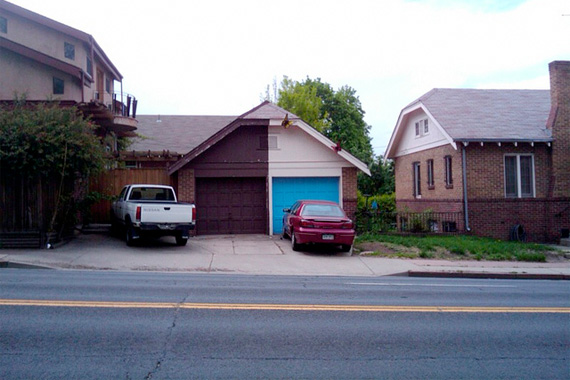 He Said, She Said
Got a difference of opinion with your significant other? If you have a double-car garage, you can express your individuality with paint. While you’re at it, inspect and maintain your garage by lubricating garage door bearings and hinges, cleaning tracks, and checking your foundation for cracks.
 Floating Garage for Your Floating Car
Only fitting that your houseboat have a garage, especially if you have an Amphicar — a combo car and boat first made in the early 1960s. A storm at sea could submerge this garage; landlocked home owners near coastal regions may want to hurricane-proof garage doors to prevent excessive damage.
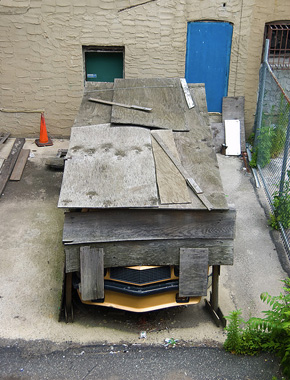 Budget-Minded Garage
According to Remodeling magazine’s annual Cost vs. Value Report, the national average cost of a garage addition is $57,824, and you’ll recoup about $33,000 of that at resale. Of course, you can build one for pennies using scrap plywood, but you have to live with the results.
 No – it’s not Pink Panther but with all this rain and humid weather we have seen a lot of ANTS! Ants and other insects can be very damaging to your home – especially if a prospective home buyer sees one in your home during a showing!
Eliminate access to food, water, and shelter to stop wood-damaging pests from bugging you. Here are some quick, non toxic and effective ways to protect your home from ants and other damaging insects!
You’ll find the materials—hardware cloth ($8 per 6-inch-square swatch), door weather stripping ($8 per 17-foot roll of 7/8-inch v-strip polypropylene), O rings for faucets (pennies)—you need at most home improvement stores.
And many of the steps to impeding pests’ access—clearing overgrowth from around foundations and disposing of wood scraps and other debris that accumulate in garages and along sides of houses—are things every homeowner should do as part of regular house and yard maintenance.
The effort—a few hours or a weekend a few times a year—and cost of supplies are well worth it to avoid having to repair thousands of dollars in damage caused by pests.
Start outside
Termites eat wood and carpenter ants tunnel into wood to nest. So remove piles of wood and other debris from around your home. The same goes for rotted stumps and logs. Keep firewood at least 20 feet away and five inches off the ground. And never bury wood scraps or waste lumber.
Maintain at least 6 inches of clearance between soil and structural wood to prevent decay, which attracts carpenter ants, and to make it tougher for termites to find their next meal.
Keep it dry
Termites, carpenter ants, and powderpost beetles thrive in moist areas, so maintain a Sahara zone around your home’s perimeter.
In general, you shouldn’t have any vegetation—bushes, shrubs, vines, trees—touching the house, which can trap moisture that causes rot and attracts pests. Many pests use vegetation as a bridge between the ground to the walls and roof of your home.
Keep foundation plantings (shrubs, bushes, perennials) and wood mulch at least 18 inches away from the foundation. Prune trees, bushes, and vines that touch or overhang the house. And don’t plant anything close to your home that’s aphid-prone, such as peonies or roses. That’s like ringing the dinner bell for carpenter ants, which feed on honeydew, a sweet liquid produced by aphids.
Even an infrequent puddle close to the house can become an oasis for pests on the prowl for food, so take measures to direct water away from the house. Drain puddles, don’t overwater flower beds, point sprinklers away from the structure, and make sure the ground near the foundation slopes away from your home. Use drain tile if the site is flat.
Clean gutters so they don’t overflow. Use downspout extensions and splash blocks to direct rainwater runoff away from the foundation. Fix dripping faucets, water pipes, and air conditioning units. Even small leaks can contribute to wood rot and moist foundations that pests find irresistible.
Deny access into your home
The tiniest gap or crack can become an express lane for pests—and not only insects. “If you can push a pencil through a hole, a mouse can get through it,” says Greg Bauman, senior scientist with the National Pest Management Association.
Inspect your home’s envelope (walls, doors, windows, roof) for possible points of entry as well as moisture-inducing leaks. Use caulk or epoxy to seal any cracks in the foundation or gaps in the structure. Use steel wool or hardware cloth (1/4-inch wire mesh) to block any openings where wires, pipes, and cables come into or out of the house.
Should you detect any moisture damage, repair it promptly. Carpenter ants flock to deteriorating wood, but often move from decayed wood into sound wood as the colony expands. Replace punky fascia, soffits, and shingles. While you’re at it, paint weathered and/or unfinished wood to stop carpenter bees from drilling holes to build their nests.
Ventilate attics and crawl spaces, and make sure vents aren’t blocked by debris or vegetation. Good air flow prevents the buildup of moisture. Cover any exposed earth in the crawl space with a plastic vapor barrier.
Make sure roof and foundation vents are protected with hardware cloth. Install screens on all floor drains and windows. And while you’re at it, caulk or install weather-stripping around windows and doors as well. Close any gap between your garage door and the floor by attaching a door sweep. And keep the door closed.
Be inhospitable
If pests do get inside, they’ll usually die or skedaddle if they can’t find anything to eat or drink.
Carpenter ants will eat almost anything you do, but are especially fond of sweet and greasy food. Put kitchen waste in a sealed trash can, sweep up crumbs, and wipe up spills right away. Termites typically feed on wood, but will eat anything with cellulose, so never store paper or cardboard—or wood—in the crawl space.
Deal with interior moisture, too. Inspect the base of toilets, around bath tubs and shower stalls, and areas where pipes go through walls, such as under sinks. Repair any leaks and wrap any pipes that produce excess condensation.
Check behind and under washing machines and dishwashers, which are notorious for leaks, to make sure there’s no condensation or old moisture damage. Fix leaky faucets; in some cases, replacing a simple O ring might not only save water, but also stave off a potential invasion of pests.
 Real Estate and *stuff *